What do UAE medical schools usually look for?
Most programmes look at the same core areas, even if the details differ. Think of these as the common building blocks of an application:
- A recognised high school certificate with strong science results
- Proof of English level, since medicine is taught in English
- An admissions test, interview or both, depending on the university
- Supporting documents such as a personal statement or references at some schools
Exact grades, test types and minimum scores change from year to year. Never rely on a forum post or an old screenshot; check the university website directly.
Step 1: Build your science base early
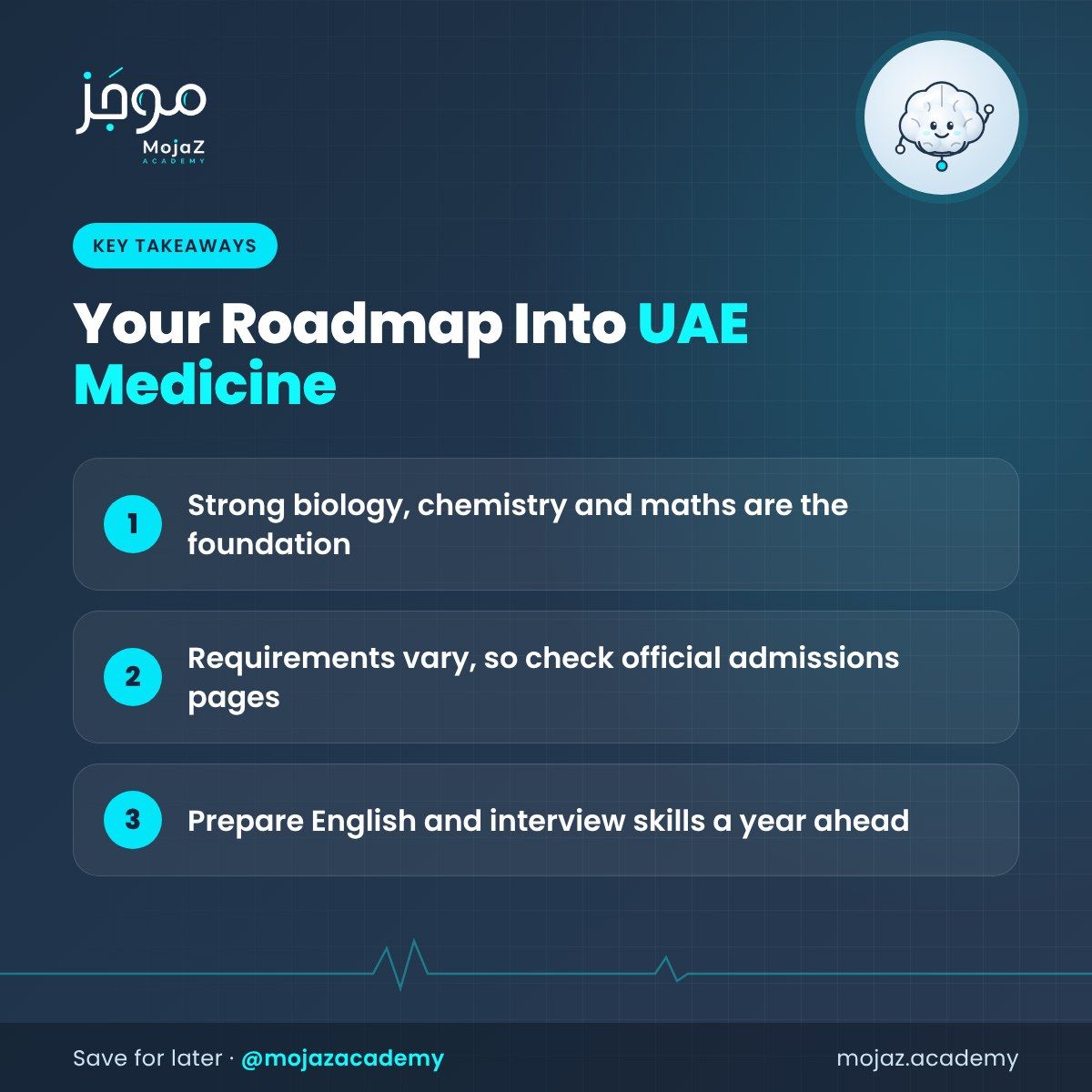
Biology and chemistry are the heart of pre-med, and maths and physics support them. Aim for real understanding, not just good marks, because the first year of medicine builds directly on these subjects.
If you are still in school, choose the science track and keep your grades steady across the final years, not only in the last term.
Step 2: Prepare your English early
Medical lectures, textbooks and exams are in English. Most universities ask for an English proficiency result, and the accepted tests and scores vary. Start preparing a year ahead so the test is not competing with your final school exams.
Step 3: Shortlist and compare programmes
Make a simple table for each university: programme length, whether there is a foundation or pre-med year, required documents and deadlines. This turns a stressful search into a clear checklist.
- Visit each official admissions page and note the requirements
- Mark application windows in your calendar
- Attend open days or online info sessions where offered
- Ask the admissions office directly when something is unclear
- Confirm the programme's recognition on official sources; the World Federation for Medical Education (WFME) publishes international quality standards for medical programmes
Step 4: Get ready for the interview and statement
Many schools want to see motivation and communication, not just grades. Practise explaining why you want medicine, what you know about the profession and how you handle pressure. Short, honest answers based on real experiences, such as volunteering or shadowing, usually work better than memorised speeches. Our guide to medical school interview tips and common questions walks you through the typical formats.
Some schools use the multiple mini-interview (MMI), a series of short, timed stations first described by Eva and colleagues (2004).
If you feel lost between options, a personal plan saves months of guessing. You can book a one-to-one academic study consultation to map your subjects, timeline and preparation in one session.
Frequently asked questions
Can I study medicine in the UAE straight after high school?
Yes, many UAE universities accept students directly from high school, sometimes through a foundation or pre-med year first. Check each programme's structure on its official website.
Do I need an English test to study medicine in the UAE?
Most programmes ask for proof of English proficiency because teaching is in English. The accepted tests and minimum scores vary, so confirm them with each university.
When should I start preparing my application?
Ideally in the year before your final school exams. That gives you time for English preparation, document collection and interview practice without last-minute pressure.
Test yourself
1. What is the most reliable first step when checking medical school entry requirements in the UAE?
- A. Reading forum posts from previous applicants
- B. Checking the official admissions page of each university
- C. Using screenshots shared in group chats
- D. Asking friends who applied in earlier years
Show answer
Answer: B. Checking the official admissions page of each university. Each university sets its own requirements and updates them often, so the official admissions page is the only reliable source.
2. Why do most UAE medical programmes ask for proof of English proficiency?
- A. Because medicine is taught in English
- B. Because it replaces science grades
- C. Because it is the only admission requirement
- D. Because it is needed only for the interview
Show answer
Answer: A. Because medicine is taught in English. Medical lectures, textbooks and exams are in English. The accepted tests and scores vary, so confirm them with each university.
3. An applicant learns that a medical school's interview uses a series of short, timed stations, each assessing a different skill. Which format is this?
- A. Panel interview
- B. Group task
- C. Recorded online interview
- D. Multiple mini-interview (MMI)
Show answer
Answer: D. Multiple mini-interview (MMI). The MMI is a series of short, timed stations, each testing a different skill. A panel interview is one conversation with two or more interviewers.
Keep learning
 How to Answer Medical MCQs: Strategies That Work
 Nursing Student Study Tips: Learn Theory and Practice Together
 The First Pass Effect Explained Simply
More in Pre-Med & Admissions →
Study this with Mojaz
References
- Eva KW, Rosenfeld J, Reiter HI, Norman GR. An admissions OSCE: the multiple mini-interview. Med Educ. 2004;38(3):314-326. DOI
- World Federation for Medical Education (WFME). Basic Medical Education: WFME Global Standards for Quality Improvement - The 2020 Revision. 2020. Source
Medically reviewed by: Lina Haddad, MD, MSc in Medical Education · Medical Education Specialist · Updated 27 Oct 2026
Want a study plan built around you?
A one-to-one Mojaz academic consultation with a personalised study plan.
Book Your ConsultationMojaz in 60 seconds, every week
Short explainers, exam tips and study tricks on our socials. Follow us and save this for later.