
Why does the first-pass effect happen?
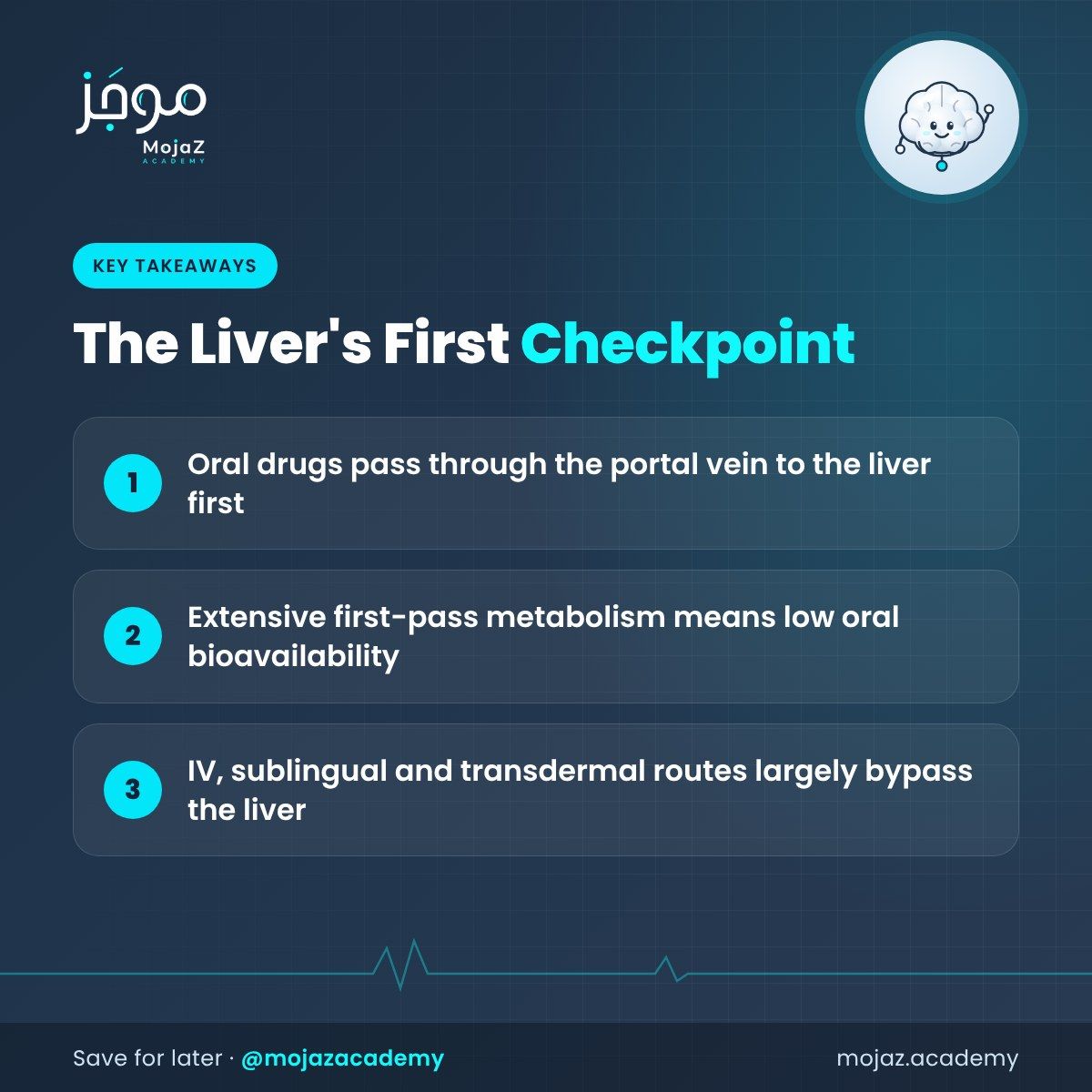
It is a matter of anatomy. Blood draining most of the gastrointestinal tract collects in the hepatic portal vein, which carries it to the liver before it returns to the heart. The liver is rich in drug-metabolising enzymes, including the cytochrome P450 family, so a drug can be partly broken down on this first passage.
- The drug is swallowed and absorbed across the gut wall.
- Some metabolism can already happen in the intestinal wall.
- The drug travels in the portal vein to the liver.
- The liver metabolises a portion of it.
- The remaining unchanged drug enters the systemic circulation.
How does it relate to bioavailability?
Bioavailability is the fraction of an administered dose that reaches the systemic circulation unchanged. By definition, a drug given intravenously has complete bioavailability because it enters the bloodstream directly. A drug with extensive first-pass metabolism has low oral bioavailability. Incomplete absorption from the gut can also lower bioavailability, so the first-pass effect is one reason, not the only one.
Which routes avoid or reduce it?
| Route | First-pass through the liver? |
|---|---|
| Oral (swallowed) | Yes |
| Intravenous | No, enters the bloodstream directly |
| Sublingual and buccal | Largely avoided; drains into systemic veins |
| Transdermal, inhaled, intramuscular | Largely avoided |
| Rectal | Partly avoided, depending on the region absorbed from |
Glyceryl trinitrate is the classic example in pharmacology texts such as Katzung's Basic and Clinical Pharmacology: it undergoes extensive first-pass metabolism, which is why it is commonly given by the sublingual route. The idea to remember is general: when the first pass is large, a route that skips the portal circulation changes how much drug reaches the body.
What else affects the first pass?
- Liver function: liver disease can reduce metabolism.
- Enzyme induction or inhibition by other substances can change how much drug is metabolised.
- Individual variation in enzyme activity, including genetic differences.
These are concepts to understand for exams; decisions about real patients are always made by qualified prescribers using official references.
Where does this fit in pharmacokinetics?
The first-pass effect sits at the meeting point of absorption and metabolism. To see the full picture, read our guide on pharmacokinetics and ADME made simple. For pharmacology material organised by your programme and year, browse the Mojaz course catalogue by university and study year.
Frequently asked questions
Is the first-pass effect only in the liver?
The liver is the main site, but some metabolism can also happen in the intestinal wall before the drug reaches the portal vein.
Why does sublingual administration avoid the first-pass effect?
Veins under the tongue drain into the systemic venous circulation rather than the hepatic portal vein, so the drug reaches the heart without passing through the liver first.
What is the bioavailability of an IV drug?
By definition it is complete, because the whole dose is placed directly into the systemic circulation without an absorption step.
Test yourself
1. Which vessel carries an orally absorbed drug from the gut to the liver before it reaches the systemic circulation?
- A. Hepatic artery
- B. Hepatic vein
- C. Hepatic portal vein
- D. Inferior vena cava
Show answer
Answer: C. Hepatic portal vein. Blood draining most of the GI tract collects in the hepatic portal vein and goes to the liver first. The hepatic vein carries blood out of the liver, after the first pass.
2. What is the bioavailability of a drug given intravenously?
- A. Low, because of first-pass metabolism
- B. Complete, because the whole dose enters the systemic circulation directly
- C. Variable, depending only on liver enzymes
- D. Lower than the same drug given orally
Show answer
Answer: B. Complete, because the whole dose enters the systemic circulation directly. By definition an IV dose has complete bioavailability: there is no absorption step and no first pass through the liver.
3. Glyceryl trinitrate undergoes extensive first-pass metabolism. Why is it commonly given by the sublingual route?
- A. Sublingual veins drain into systemic veins, bypassing the portal circulation
- B. Saliva activates the drug before swallowing
- C. The sublingual route delivers the drug to the liver faster
- D. The sublingual route increases liver metabolism
Show answer
Answer: A. Sublingual veins drain into systemic veins, bypassing the portal circulation. Veins under the tongue drain into the systemic venous circulation, so the drug reaches the heart without passing through the liver first.
Keep learning
 How to Answer Medical MCQs: Strategies That Work
 Cell Cycle and Apoptosis Explained Simply
 How to Get Into Medical School in the UAE: A Clear Roadmap
Study this with Mojaz
References
- Vanderah TW. Katzung's Basic and Clinical Pharmacology. 16th ed. McGraw Hill; 2024. Source
- Ritter JM, Flower RJ, Henderson G, Loke YK, MacEwan D, Robinson E, Fullerton J. Rang & Dale's Pharmacology. 10th ed. Elsevier; 2024. Source
Medically reviewed by: Rana Mansour, PharmD, MSc in Clinical Pharmacy · Clinical Pharmacy Educator · Updated 27 Oct 2026
Find your subject, made brief
Mojaz courses sorted by university, programme and study year.
Browse coursesMojaz in 60 seconds, every week
Short explainers, exam tips and study tricks on our socials. Follow us and save this for later.