
Step 1: Read the question before the story
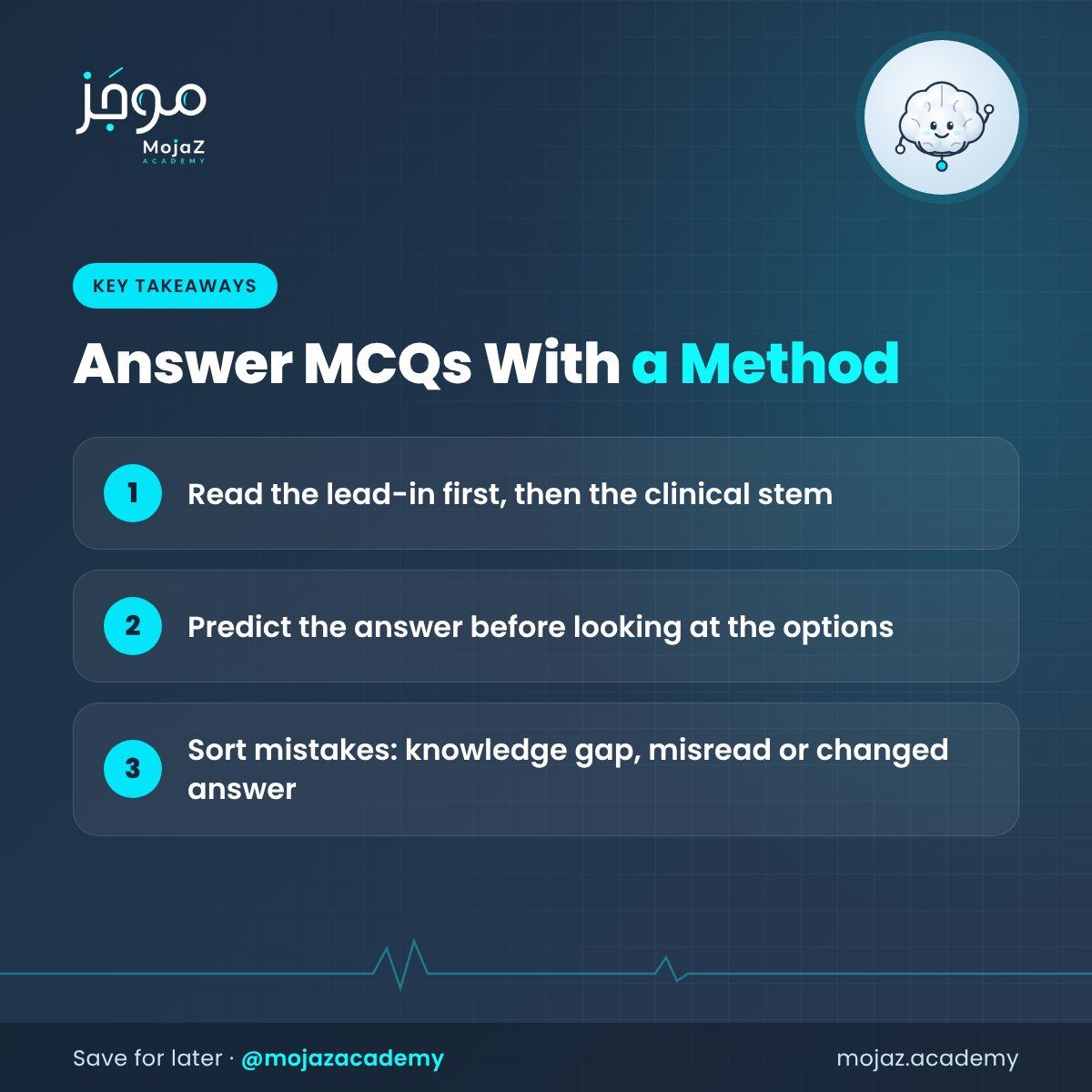
Long clinical stems can bury the real question. Read the lead-in first, for example 'Which nerve is most likely injured?' or 'What is the mechanism of action?'. Now you know what to look for while reading the stem.
- Underline age, sex, timeline and the key finding.
- Notice words like 'most likely', 'best next' or 'except'.
- Ignore details that do not change the answer.
Reading this way turns a long paragraph into a short checklist of clues you can actually use.
Step 2: Predict, then look at the options
Before reading the choices, try to predict the answer in your head. If your prediction is in the list, choose it with more confidence; if not, reread the stem for a clue you missed. This works because well-written single-best-answer questions are designed to be answerable with the options covered (Billings et al., 2020).
This habit protects you from distractors that are true statements but do not answer the specific question. It also trains you for exams where you must recall facts without any options, such as short-answer or viva questions.
Step 3: Eliminate with reasons
Use elimination actively. Cross out each option for a clear reason: wrong system, wrong timeline, wrong mechanism, or true but irrelevant. Going from five options to two is a real advantage even when you are unsure.
| Option type | How to spot it |
|---|---|
| Correct | Answers the exact lead-in |
| True but irrelevant | A real fact, wrong question |
| Partly right | Fits one clue, misses another |
| Extreme wording | 'Always' or 'never' in biology |
Step 4: Manage time and changing answers
Set a pace per question and flag hard ones instead of getting stuck. Come back at the end with fresh eyes.
- Change an answer only when you find a clear reason, such as a clue you missed.
- Do not change answers because of a vague feeling.
- Leave no question blank unless your exam uses negative marking; check your exam rules.
Step 5: Build MCQ skill before exam day
MCQ technique improves with deliberate practice. Do timed blocks, then review every answer, including the ones you got right by luck; repeated testing also strengthens long-term retention in medical education (Larsen et al., 2008). Our guide on using past papers the right way explains how to turn practice into real learning.
Strong technique still needs strong content. If you want structured study material organised by your university, programme and year, browse the Mojaz course catalogue and pick the subjects you are preparing for.
Frequently asked questions
Should I read the options first in medical MCQs?
It usually works better to read the lead-in, then the stem, and predict the answer before looking at the options. This reduces the pull of distractors.
Is my first answer usually right?
Not always. Change an answer when you find a clear reason, like a clue you missed, but avoid changing it based on a vague feeling.
How can I get faster at MCQs?
Practise timed blocks regularly, flag hard questions instead of getting stuck, and review every answer so patterns become familiar.
Test yourself
1. In a long clinical MCQ, which part should you read first?
- A. The first sentence of the stem
- B. All the answer options
- C. The lead-in (the actual question in the last line)
- D. The laboratory values
Show answer
Answer: C. The lead-in (the actual question in the last line). Reading the lead-in first tells you what to look for, so the stem becomes a checklist of useful clues instead of a long story.
2. Why is it useful to predict the answer before looking at the options in a single-best-answer question?
- A. It reduces the pull of distractors that are true but do not answer the question
- B. It means you no longer need to read the stem
- C. It removes the need to eliminate any options
- D. It only matters in exams with negative marking
Show answer
Answer: A. It reduces the pull of distractors that are true but do not answer the question. Well-written single-best-answer questions can be answered with the options covered. Predicting first protects you from attractive true-but-irrelevant options.
3. During final checks, a student wants to change an answer because of a vague feeling, though no new clue has been found. What is the best approach?
- A. Always change it, since first answers are usually wrong
- B. Change it to the longest option
- C. Leave the question blank instead
- D. Keep the original answer unless a clear reason, such as a missed clue, appears
Show answer
Answer: D. Keep the original answer unless a clear reason, such as a missed clue, appears. Change an answer only for a clear reason, like a clue you missed. Changing because of a vague feeling is a common way to lose marks on questions you had right.
Keep learning
 Active Recall for Medical Students: How to Actually Use It
 The First Pass Effect Explained Simply
 How to Get Into Medical School in the UAE: A Clear Roadmap
Study this with Mojaz
References
- Billings MS, DeRuchie K, Hussie K, Kulesher A, Merrell J, Morales A, et al. Constructing Written Test Questions for the Health Sciences (NBME Item-Writing Guide), 6th edition. National Board of Medical Examiners (NBME); 2020. Source
- Larsen DP, Butler AC, Roediger HL 3rd. Test-enhanced learning in medical education. Med Educ. 2008;42(10):959-966. DOI
- Roediger HL 3rd, Karpicke JD. Test-enhanced learning: taking memory tests improves long-term retention. Psychol Sci. 2006;17(3):249-255. DOI
Medically reviewed by: Dana Saleh, MSc in Healthcare Education · Healthcare Training Specialist · Updated 27 Oct 2026
Find your subject, made brief
Mojaz courses sorted by university, programme and study year.
Browse coursesMojaz in 60 seconds, every week
Short explainers, exam tips and study tricks on our socials. Follow us and save this for later.