
What does a normal week look like?
Most weeks mix lectures, labs, small-group sessions and self-study. In the early years the focus is on the basic sciences such as anatomy, physiology and biochemistry; clinical exposure grows as you progress.
- Lectures move fast, so pre-reading the topic for even ten minutes can make them easier to follow.
- Labs and practicals reward students who reviewed the material beforehand.
- Evenings usually go to review, assignments and catching up.
Is studying in English a problem?
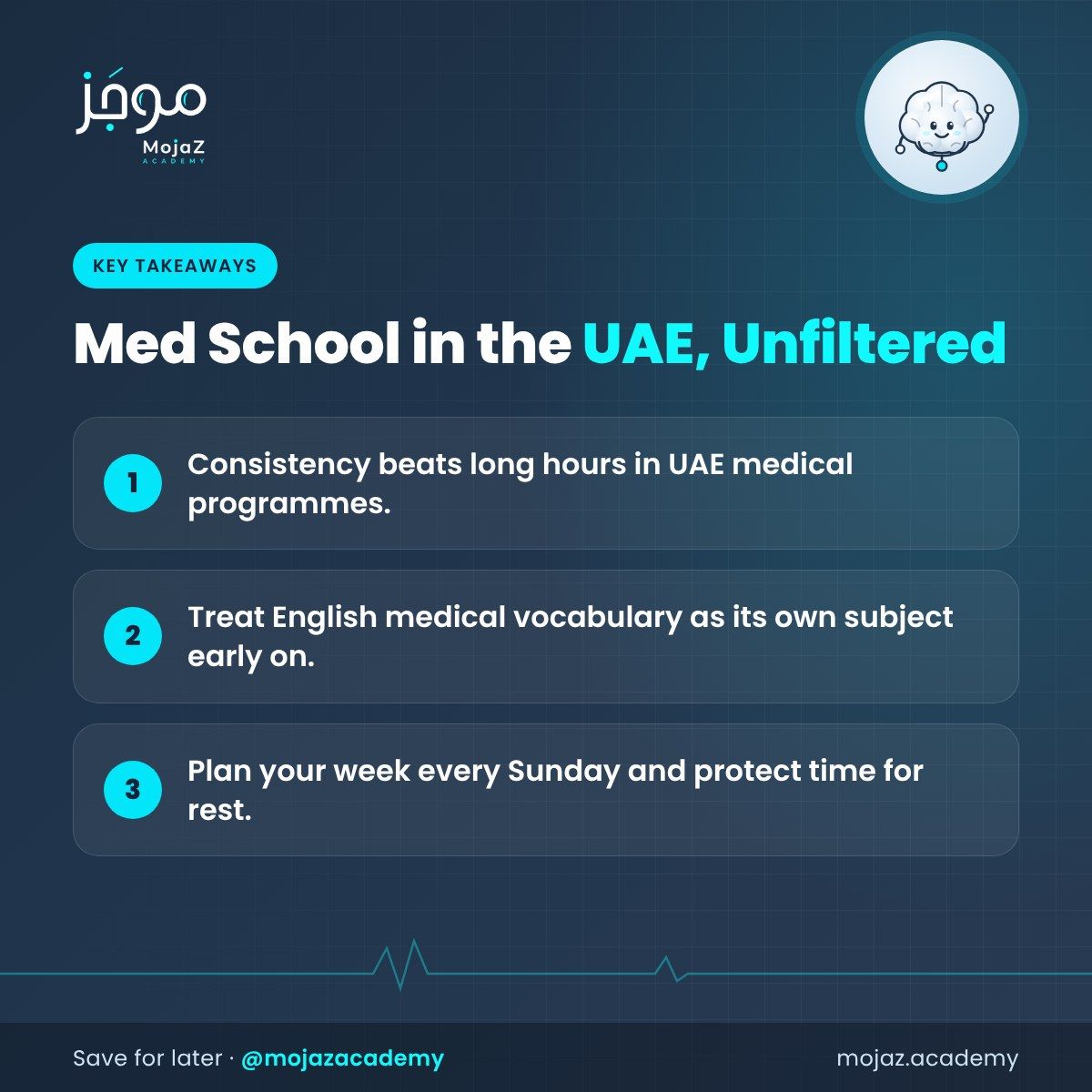
For many Arab students it is the biggest early adjustment. You may understand a concept perfectly in Arabic but struggle to recall the English term in an exam. The fix is to treat medical vocabulary as its own subject in the first months: learn prefixes, suffixes and roots so new words become easy to decode.
If English is your second language, our guide to studying medicine in English as an Arabic speaker walks through practical habits that help.
How intense are the exams?
Assessment is frequent. Alongside midterms and finals you will often have quizzes, practical exams and assignments, which means there is rarely a quiet week. The upside is that spaced, regular reviews lead to better retention than last-minute cramming (Cepeda et al., 2006).
- Keep a simple calendar of every assessment from week one.
- Review each lecture within a few days, not at the end of the block.
- Use past questions to learn the style your faculty uses.
Is there time for a social life?
Yes, if you plan it. Campus clubs, student societies and friendships with classmates from many nationalities are a real part of studying in the UAE. Protecting one or two fixed slots a week for family, sport or friends helps you stay balanced instead of feeling guilty every time you rest.
Where can you get support?
Your university offers academic advisors, tutoring and counselling services, and using them early is a sign of good judgement, not weakness. Senior students are also a great source of practical advice about specific courses.
When you want structured help with a specific subject, the Mojaz course catalogue lists courses by university, programme and study year, so you can find material that matches what you are studying right now.
Frequently asked questions
Is medical school in the UAE taught in English?
Medical programmes in the UAE are generally taught in English. Check each university's official website for its language and admission requirements.
How many hours a day do medical students study?
It varies by student and by period. Most students do better with steady daily review alongside lectures than with occasional long sessions before exams.
Can medical students in the UAE have a social life?
Yes. Planning your week and protecting a few fixed slots for friends, family or sport makes it realistic, even during busy blocks.
Test yourself
1. For many Arab students starting medicine in English, what fix does the article suggest for recalling English terms?
- A. Translate every lecture fully into Arabic
- B. Treat medical vocabulary as its own subject: learn prefixes, suffixes and roots
- C. Avoid English terms until the clinical years
- D. Rely only on Arabic summaries
Show answer
Answer: B. Treat medical vocabulary as its own subject: learn prefixes, suffixes and roots. Learning prefixes, suffixes and roots in the first months makes new terms easy to decode, which helps when a concept is understood in Arabic but the English term is hard to recall.
2. What does spacing research (Cepeda et al., 2006) suggest about exam preparation?
- A. Cramming the night before gives the best retention
- B. Rereading once is enough
- C. Total hours matter more than timing
- D. Spaced, regular reviews lead to better retention than cramming
Show answer
Answer: D. Spaced, regular reviews lead to better retention than cramming. Spreading reviews over time leads to better retention than last-minute cramming, which is why reviewing each lecture within a few days helps.
3. A medical student feels guilty every time she rests and is close to burnout. Which change fits the article's advice?
- A. Protect one or two fixed weekly slots for family, sport or friends
- B. Remove all breaks until the exams end
- C. Study only at night to free the day
- D. Skip lectures to make time for rest
Show answer
Answer: A. Protect one or two fixed weekly slots for family, sport or friends. Planning a few fixed slots each week for family, sport or friends helps students stay balanced instead of feeling guilty every time they rest.
Keep learning
 Nursing Student Study Tips: Learn Theory and Practice Together
 How to Get Into Medical School in the UAE: A Clear Roadmap
 How to Answer Medical MCQs: Strategies That Work
Study this with Mojaz
References
- Cepeda NJ, Pashler H, Vul E, Wixted JT, Rohrer D. Distributed practice in verbal recall tasks: a review and quantitative synthesis. Psychol Bull. 2006;132(3):354-380. DOI
- Dunlosky J, Rawson KA, Marsh EJ, Nathan MJ, Willingham DT. Improving students' learning with effective learning techniques: promising directions from cognitive and educational psychology. Psychol Sci Public Interest. 2013;14(1):4-58. DOI
- Zimmerman BJ. Becoming a self-regulated learner: an overview. Theory Pract. 2002;41(2):64-70. DOI
Medically reviewed by: Kareem Nasser, MD, MSc in Healthcare Management · Medical Training Consultant · Updated 27 Oct 2026
Find your subject, made brief
Mojaz courses sorted by university, programme and study year.
Browse coursesMojaz in 60 seconds, every week
Short explainers, exam tips and study tricks on our socials. Follow us and save this for later.