
Where does the cell start? The resting membrane potential
At rest, a typical neuron sits at about -70 mV, negative inside compared with outside; the exact value varies between cell types. This resting membrane potential exists mainly because the membrane is more permeable to K+ at rest, and K+ tends to leak out down its concentration gradient.
The Na+/K+ ATPase keeps the gradients in place by pumping 3 Na+ out and 2 K+ in for each ATP used. Remember: high Na+ outside, high K+ inside.
The five phases step by step
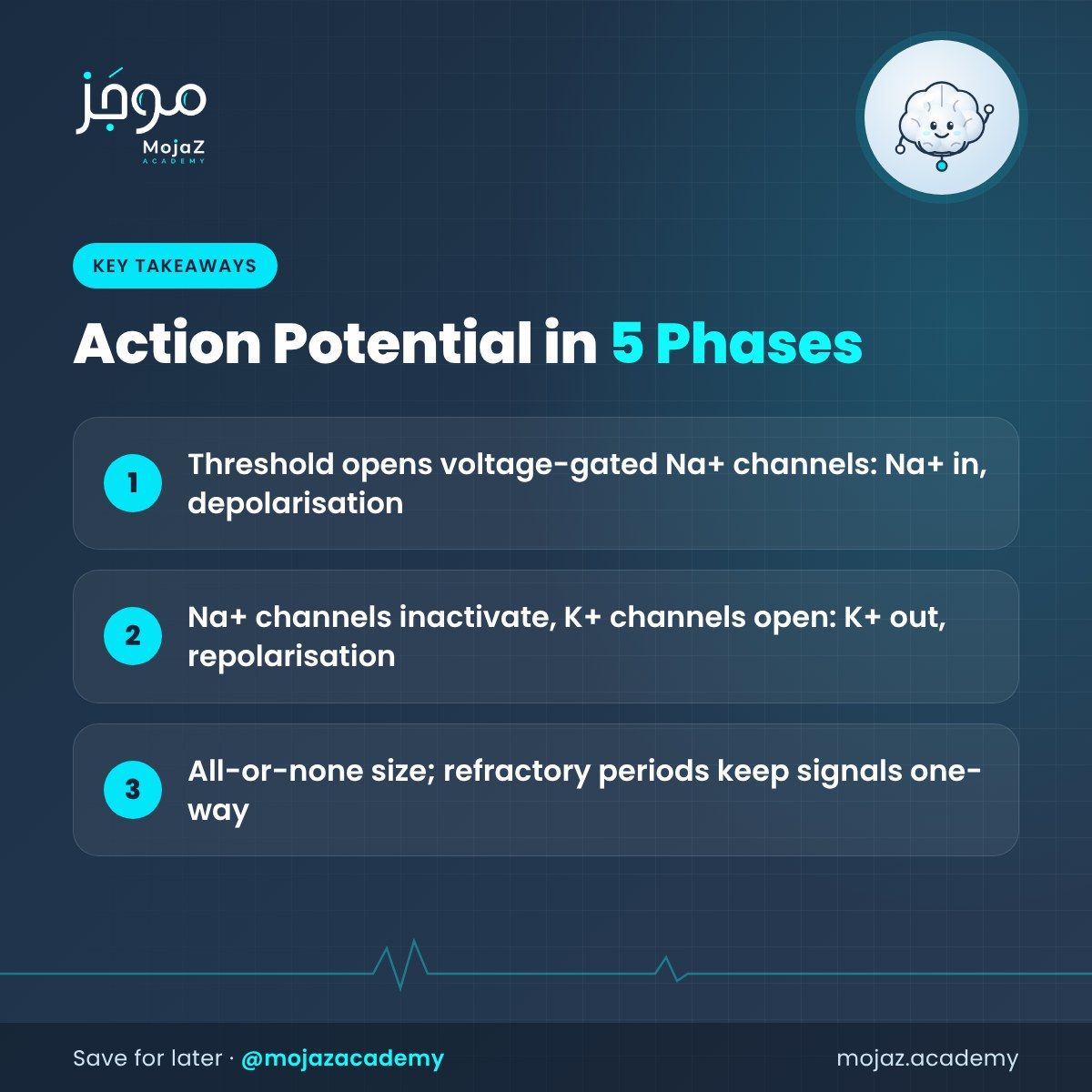
- Stimulus to threshold: a stimulus depolarises the membrane. If it reaches threshold (around -55 mV in a typical neuron), an action potential fires.
- Depolarisation: voltage-gated Na+ channels open quickly. Na+ enters the cell and the inside becomes positive, peaking at roughly +30 mV.
- Repolarisation: Na+ channels inactivate and voltage-gated K+ channels open. K+ leaves the cell and the potential falls back toward negative.
- Hyperpolarisation: K+ channels close slowly, so extra K+ leaves and the membrane briefly dips below the resting value.
- Return to rest: the K+ channels close and leak channels plus the pump restore the resting potential.
The key idea, as described in Guyton and Hall, is timing: sodium channels are fast to open and then inactivate, while potassium channels are slower to open and slower to close.
What are the refractory periods?
During the absolute refractory period, no second action potential can fire, however strong the stimulus, because the Na+ channels are inactivated. During the relative refractory period, a stronger than normal stimulus is needed, because some Na+ channels have recovered but K+ is still leaving the cell.
Refractory periods make the signal travel in one direction and limit how fast a neuron can fire.
Why is it called all-or-none, and how does it travel?
Once threshold is reached, the action potential has the same size every time. A stronger stimulus does not make a bigger action potential; it makes action potentials fire more often. This is the all-or-none principle.
The signal spreads along the axon as each depolarised segment brings the next segment to threshold. In myelinated axons the action potential jumps between nodes of Ranvier, which is called saltatory conduction and is much faster. You will see this again when comparing gray and white matter conduction.
How is this tested in exams?
Questions usually change one thing and ask you to predict the effect: blocking Na+ channels, changing extracellular K+, or applying a stimulus during the refractory period. Answer by asking which channel or gradient is affected. For lessons that walk through physiology topics for your programme and year, explore the Mojaz course catalogue.
Frequently asked questions
What causes the resting membrane potential?
Mainly the membrane's higher permeability to K+ at rest, with K+ leaking out down its concentration gradient. The Na+/K+ ATPase maintains the ion gradients that make this possible.
Why does hyperpolarisation happen after an action potential?
Voltage-gated K+ channels close slowly, so K+ keeps leaving for a short time and the membrane becomes briefly more negative than at rest.
Does a stronger stimulus make a bigger action potential?
No. Action potentials are all-or-none. A stronger stimulus increases how often action potentials fire, not their size.
Test yourself
1. Which ion movement causes the depolarisation phase of a neuronal action potential?
- A. K+ leaving through voltage-gated K+ channels
- B. Na+ entering through voltage-gated Na+ channels
- C. Na+ pumped out by the Na+/K+ ATPase
- D. K+ entering through leak channels
Show answer
Answer: B. Na+ entering through voltage-gated Na+ channels. At threshold, voltage-gated Na+ channels open quickly and Na+ rushes in, making the inside positive. K+ leaving through voltage-gated K+ channels causes repolarisation, not depolarisation.
2. Why does the membrane briefly hyperpolarise after an action potential?
- A. Na+ channels stay open too long
- B. The Na+/K+ ATPase stops working
- C. Voltage-gated K+ channels close slowly, so extra K+ leaves
- D. Chloride ions leave the cell
Show answer
Answer: C. Voltage-gated K+ channels close slowly, so extra K+ leaves. Voltage-gated K+ channels are slow to close, so K+ keeps leaving for a short time and the membrane dips below the resting value before returning to rest.
3. During the absolute refractory period, a researcher applies a very strong stimulus to an axon. What happens?
- A. A larger action potential fires
- B. An action potential fires because the stimulus is strong enough
- C. A smaller action potential fires
- D. No action potential fires, however strong the stimulus
Show answer
Answer: D. No action potential fires, however strong the stimulus. In the absolute refractory period the Na+ channels are inactivated, so no second action potential can fire. Only in the relative refractory period can a stronger than normal stimulus trigger one.
Keep learning
 Cell Cycle and Apoptosis Explained Simply
 How to Study Anatomy Without Memorising Everything
 How to Learn Medical Terminology Fast (Without Cramming)
Study this with Mojaz
References
- Hall JE, Hall ME. Guyton and Hall Textbook of Medical Physiology. 15th ed. Elsevier; 2026. Source
- Costanzo LS. Costanzo Physiology. 8th ed. Elsevier; 2027. Source
Medically reviewed by: Nael Murad, MBBS, MSc in Human Anatomy · Anatomy & Physiology Instructor · Updated 27 Oct 2026
Find your subject, made brief
Mojaz courses sorted by university, programme and study year.
Browse coursesMojaz in 60 seconds, every week
Short explainers, exam tips and study tricks on our socials. Follow us and save this for later.