
Why does anatomy feel impossible to memorise?
Most students try to learn anatomy as a list of names. Lists have no internal logic, so they fade within days. Anatomy is actually a connected system: nerves follow predictable paths, muscles act on the joints they cross, and arteries are often named after the regions they supply.
The three-question method
For every structure you meet, answer these before moving on:
- Position: where is it, and what lies in front, behind, above and below it?
- Function: what does it do, or what does it supply or drain?
- Relations: what nerve, artery or space is close to it, and why does that matter?
A muscle stops being a random name once you know it crosses the shoulder, flexes it, and shares a nerve with its neighbours.
Use function to predict, not memorise
Many facts can be reasoned out instead of stored. If a muscle lies in the anterior compartment of the arm, it is probably a flexor supplied by the same nerve as the other muscles in that compartment. If you know which nerve supplies a muscle group, you can predict what weakness follows when that nerve is injured.
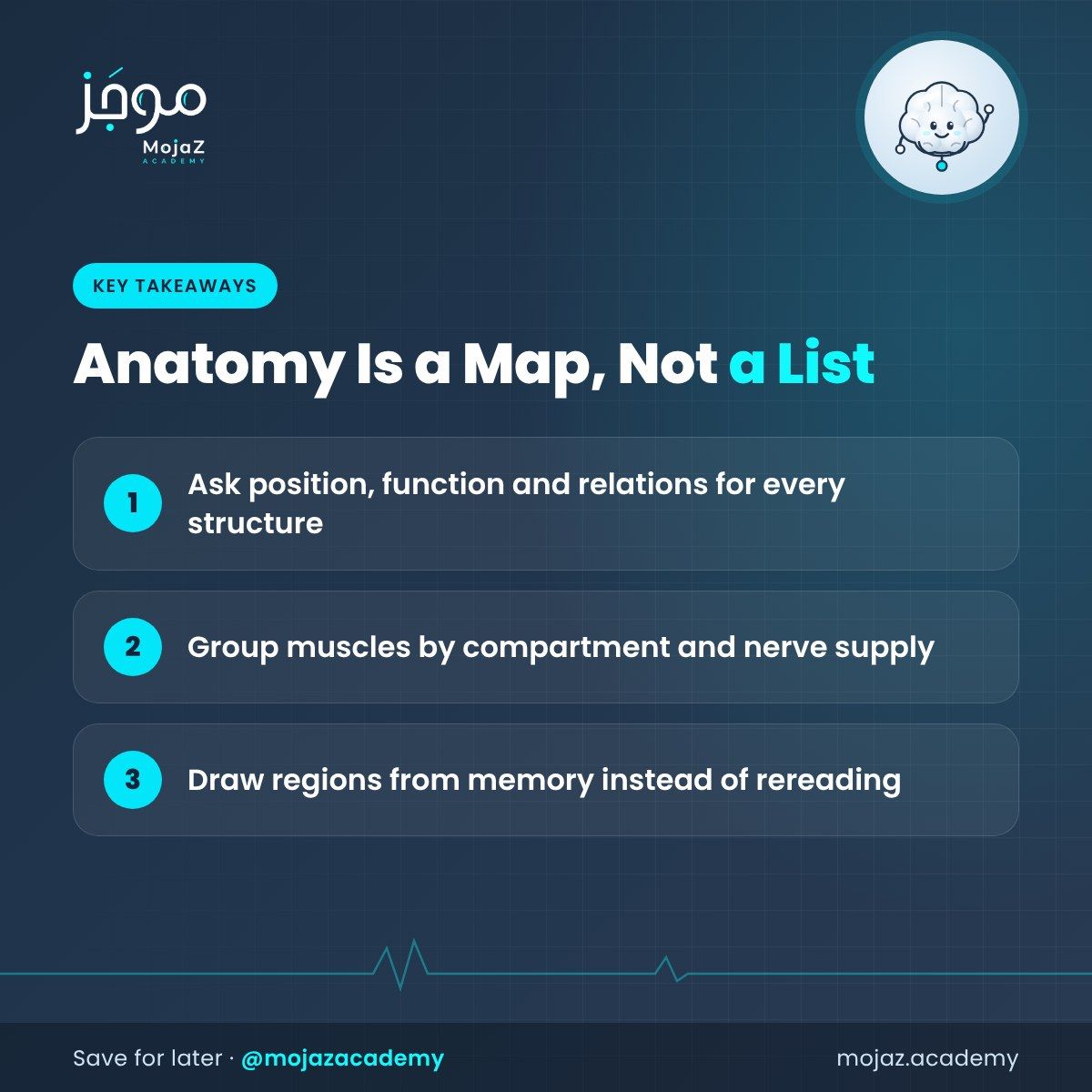
- Group muscles by compartment and shared nerve supply.
- Trace nerves and vessels from origin to destination as one continuous story.
- Ask what would go wrong clinically if the structure were damaged.
Learn in layers, region by region
Start with bones and landmarks, because everything else attaches to them. Then add muscles, then nerves and vessels, then the spaces and relations. This layered approach mirrors how dissection works and keeps each session focused. Deciding between region-by-region and system-by-system study also matters; see regional vs systemic anatomy for how to choose.
Make your study active
Rereading feels productive but builds less lasting memory than retrieving the material yourself (Karpicke & Roediger, 2008). Active recall means closing the book and rebuilding the region from memory.
- Draw a blank diagram and label it without looking.
- Explain a nerve pathway out loud as if teaching a friend.
- Use mnemonics only for true lists, such as the order of branches.
- Review the same region again after a few days to strengthen it.
Anatomy rewards a clear sequence that matches your university's syllabus and exam style. If you want guided material organised by your programme and study year, browse the Mojaz course catalogue by university and year. Pair it with your own drawings and recall sessions, and anatomy becomes a subject you understand rather than one you cram.
Frequently asked questions
Can you study anatomy without memorising?
Not entirely, because names still need to be learned. But understanding position, function and relations means you memorise far less and remember it for longer.
What should I learn first in anatomy?
Start with bones and surface landmarks, then add muscles, nerves and vessels in layers. Everything else attaches to or runs along the skeleton.
Are mnemonics useful for anatomy?
Yes, for genuine lists such as the order of branches or bones. Use them as a backup to understanding, not as a replacement for it.
Test yourself
1. In the three-question method for studying anatomy, which three things should you answer for every structure?
- A. Its Latin name, eponym and spelling
- B. Its embryology, histology and pathology
- C. Its position, function and relations
- D. Its colour, size and weight
Show answer
Answer: C. Its position, function and relations. For each structure, ask where it is, what it does or supplies, and what lies close to it. These links replace much of the pure memorisation of name lists.
2. Which order of layers is recommended when learning a new anatomical region?
- A. Bones and landmarks, then muscles, then nerves and vessels, then spaces and relations
- B. Nerves first, then bones, then muscles
- C. Spaces and relations first, then bones
- D. Muscles first, then bones, then landmarks
Show answer
Answer: A. Bones and landmarks, then muscles, then nerves and vessels, then spaces and relations. Start with bones and landmarks because everything else attaches to them, then add muscles, nerves and vessels, and finally spaces and relations, mirroring dissection.
3. A student rereads her notes on the arm three times before an exam. Which change best applies active recall?
- A. Highlighting the notes in more colours
- B. Closing the book and labelling a blank diagram from memory
- C. Rewriting the notes neatly
- D. Reading the textbook chapter aloud
Show answer
Answer: B. Closing the book and labelling a blank diagram from memory. Active recall means retrieving the material yourself, for example labelling a blank diagram without looking. Rereading, highlighting and rewriting feel productive but build less lasting memory.
Keep learning
 Active Recall for Medical Students: How to Actually Use It
 How to Learn Medical Terminology Fast (Without Cramming)
 The Action Potential Explained Step by Step
Study this with Mojaz
References
- Dalley AF II, Agur AMR. Moore's Clinically Oriented Anatomy. 10th ed. Wolters Kluwer; 2026. Source
- Drake RL, Vogl AW, Mitchell AWM. Gray's Anatomy for Students. 5th ed. Elsevier; 2024. Source
- Karpicke JD, Roediger HL 3rd. The critical importance of retrieval for learning. Science. 2008;319(5865):966-968. DOI
- Cepeda NJ, Pashler H, Vul E, Wixted JT, Rohrer D. Distributed practice in verbal recall tasks: a review and quantitative synthesis. Psychol Bull. 2006;132(3):354-380. DOI
Medically reviewed by: Nael Murad, MBBS, MSc in Human Anatomy · Anatomy & Physiology Instructor · Updated 27 Oct 2026
Find your subject, made brief
Mojaz courses sorted by university, programme and study year.
Browse coursesMojaz in 60 seconds, every week
Short explainers, exam tips and study tricks on our socials. Follow us and save this for later.