
What are the phases of the cell cycle?
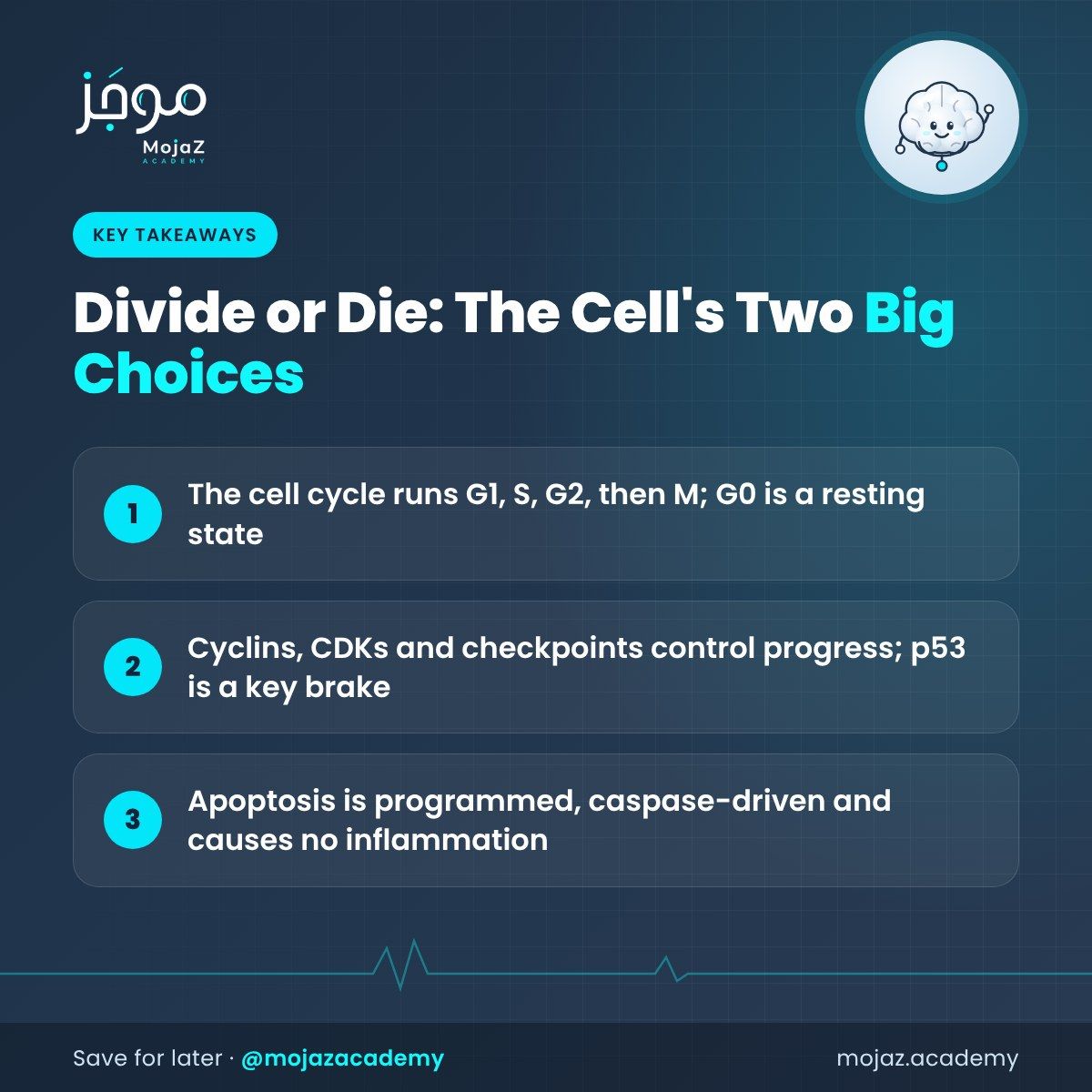
The cycle has two big parts: interphase (G1, S, G2), where the cell grows and prepares, and the M phase, where it divides.
- G1: the cell grows, makes proteins and organelles, and checks whether conditions are right to divide.
- S phase: DNA is replicated, so each chromosome now has two sister chromatids.
- G2: the cell keeps growing and checks that DNA was copied correctly.
- M phase: mitosis (nuclear division) followed by cytokinesis (splitting of the cytoplasm).
Cells that stop dividing, such as most mature neurons, leave G1 and enter a resting state called G0.
Who controls the cycle?
Progress is driven by cyclins and cyclin-dependent kinases (CDKs). Cyclin levels rise and fall through the cycle, and each cyclin-CDK pair pushes the cell past a specific stage.
Checkpoints act as quality control: the G1/S checkpoint, the G2/M checkpoint and the spindle checkpoint in mitosis. Two classic brakes are p53, which can halt the cycle when DNA is damaged, and the Rb protein, which holds the cell in G1 until it is released.
What happens during apoptosis?
Apoptosis is a tidy, step-by-step shutdown. The cell shrinks, its chromatin condenses, the DNA is cut into fragments, and the membrane forms blebs that break off as apoptotic bodies. Neighbouring phagocytes swallow these pieces, so there is no inflammation.
As Robbins & Kumar Basic Pathology describes, there are two main pathways, and both end by activating enzymes called caspases:
- Intrinsic (mitochondrial) pathway: internal stress such as DNA damage causes mitochondria to release cytochrome c. The Bcl-2 family controls this step: Bcl-2 itself blocks apoptosis, while Bax and Bak promote it.
- Extrinsic (death receptor) pathway: an outside signal binds a death receptor on the cell surface, such as Fas or the TNF receptor.
Apoptosis vs necrosis: what is the difference?
| Feature | Apoptosis | Necrosis |
|---|---|---|
| Cell size | Shrinks | Swells |
| Membrane | Stays intact, forms blebs | Ruptures |
| Inflammation | None | Present |
| Control | Programmed, energy-dependent | Accidental, due to injury |
Why does this matter in medicine?
When the cell cycle loses its brakes and cells also escape apoptosis, uncontrolled growth can follow. That is why mutations in genes like p53 appear so often in cancer biology. Apoptosis is also normal and essential: it shapes the fingers during embryonic development and removes self-reactive immune cells.
Once this clicks, the details of division itself become much easier. Read our guide to mitosis vs meiosis next, and use the Mojaz medical reference guide to recommended textbooks to find the right cell biology book for your year.
Frequently asked questions
What is the difference between apoptosis and necrosis?
Apoptosis is programmed and controlled: the cell shrinks and is removed without inflammation. Necrosis is accidental cell death from injury: the cell swells, bursts and triggers inflammation.
In which phase of the cell cycle is DNA replicated?
DNA is replicated in the S (synthesis) phase, which sits between G1 and G2 in interphase.
What does p53 do in the cell cycle?
p53 is a tumour suppressor protein. When DNA is damaged, it can pause the cycle to allow repair, or push the cell towards apoptosis if the damage is too severe.
Test yourself
1. In which phase of the cell cycle is DNA replicated?
- A. G1 phase
- B. G2 phase
- C. S phase
- D. M phase
Show answer
Answer: C. S phase. DNA is copied in the S (synthesis) phase of interphase, so each chromosome then has two sister chromatids. G2 checks the copy; it does not make it.
2. Which feature is characteristic of apoptosis rather than necrosis?
- A. The cell swells and its membrane ruptures
- B. It is accidental and caused by injury
- C. The cell shrinks and is removed without inflammation
- D. It triggers a strong inflammatory response
Show answer
Answer: C. The cell shrinks and is removed without inflammation. In apoptosis the cell shrinks, forms blebs and apoptotic bodies, and is eaten by phagocytes without inflammation. Swelling, rupture and inflammation describe necrosis.
3. A cell with damaged DNA has a normal, working p53 protein. What is the most likely outcome?
- A. The cycle pauses for repair, or the cell undergoes apoptosis if damage is severe
- B. The cell skips G2 and divides faster
- C. The cell undergoes necrosis with inflammation
- D. The cell copies its DNA again in a second S phase
Show answer
Answer: A. The cycle pauses for repair, or the cell undergoes apoptosis if damage is severe. p53 is a tumour suppressor: it halts the cycle so DNA can be repaired, or pushes the cell towards apoptosis if the damage is too great. Loss of p53 is common in cancer.
Keep learning
 The Action Potential Explained Step by Step
 The First Pass Effect Explained Simply
 How to Study Anatomy Without Memorising Everything
More in Biochemistry & Cell Biology →
Study this with Mojaz
References
- Kumar V, Abbas AK, Aster JC, Deyrup AT. Robbins & Kumar Basic Pathology. 11th ed. Elsevier; 2023. Source
- Alberts B, Heald R, Johnson A, Morgan D, Raff M, Roberts K, Walter P. Molecular Biology of the Cell. 7th ed. W.W. Norton; 2022. Source
Medically reviewed by: Mazen Faris, MSc, PhD in Biomedical Sciences · Biomedical Sciences Lecturer · Updated 27 Oct 2026
Which textbook for which subject?
The Mojaz medical reference guide: the right book for every subject and year.
Open the reference guideMojaz in 60 seconds, every week
Short explainers, exam tips and study tricks on our socials. Follow us and save this for later.