
Why word parts beat memorising lists
Most medical terms are built from Greek and Latin pieces that repeat again and again. If you know that cardi/o means heart, -itis means inflammation and -megaly means enlargement, then carditis and cardiomegaly explain themselves.
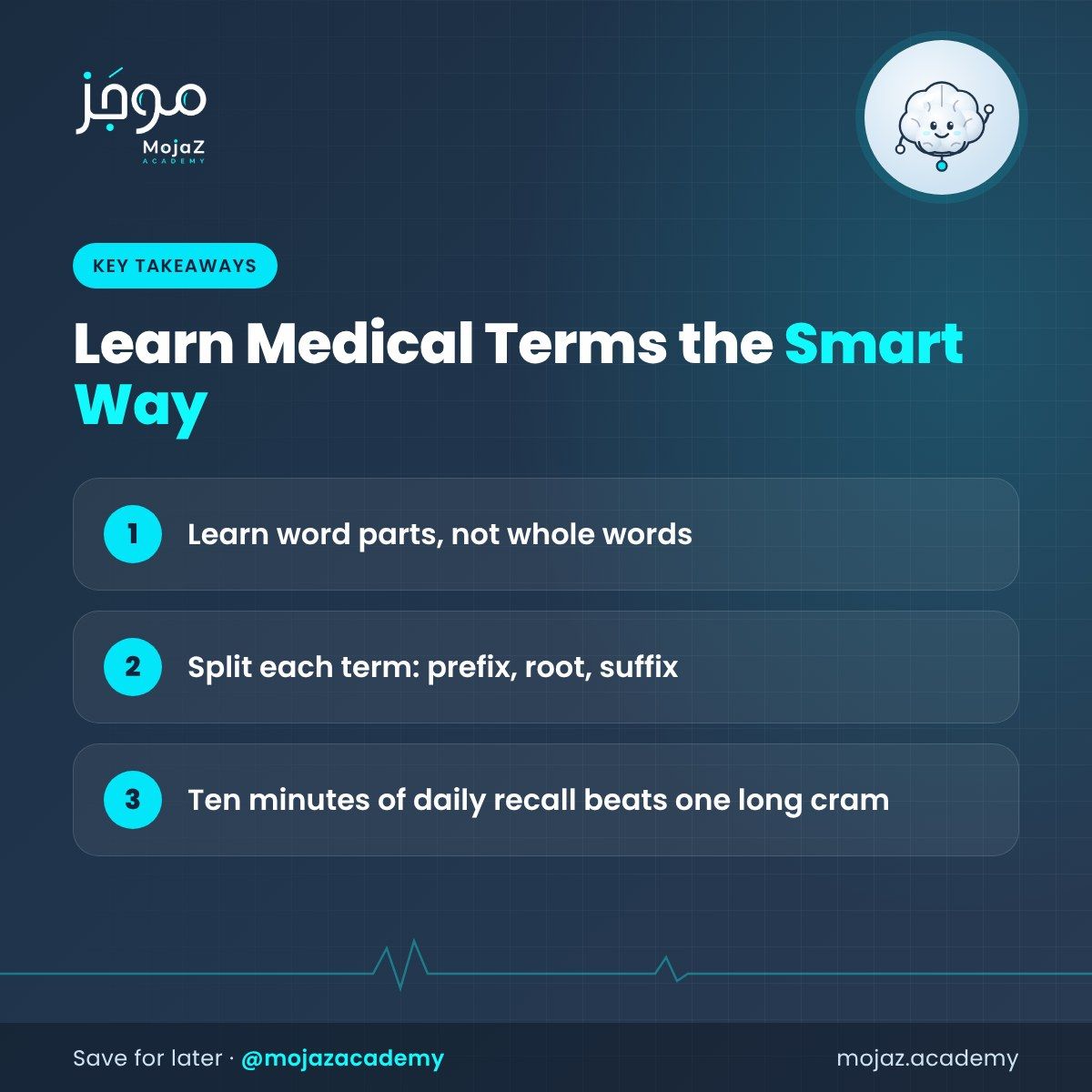
A list of 500 whole words is hard to hold in memory. A set of word parts that combine into those 500 words is much lighter, and it keeps working in every new subject.
A simple method that works
- Split every new term into prefix, root, combining vowel and suffix. Write the split, not just the word.
- Read it from the end: the suffix usually tells you what kind of word it is (a condition, a procedure, a measurement), then the root tells you where.
- Group by body system: learn cardiovascular roots together, then respiratory, then digestive. Your anatomy and physiology lectures will reinforce them.
- Say it out loud and write it once by hand. Producing the word yourself makes you notice its parts, sound and spelling.
- Test yourself instead of rereading: cover the meaning and try to build it from the parts.
Use active recall and spaced review
Terminology is a perfect match for active recall. Make short cards with the word part on one side and the meaning plus one example term on the other. Review new cards the next day, then after a few days, then after a week.
Short daily sessions work better than one long session before a quiz: spacing flashcard practice beats cramming, even though cramming feels more effective at the time (Kornell, 2009). If you want a ready schedule, see our guide to a simple spaced repetition schedule for medicine.
Common mistakes that slow you down
- Translating every term into Arabic and memorising the translation. Learn the meaning, but keep thinking in the English term, because that is how your exams and textbooks are written.
- Ignoring look-alike parts such as hyper- and hypo-, or -ectomy and -otomy. Put confusing pairs side by side on one card.
- Learning parts with no example. Always attach one real term so the part has a home in your memory.
Where to go next
Start with the most common prefixes and suffixes, then build your root words system by system. If you want a structured path with every word part organised for you, the Mojaz Medical Terminology course takes you through the building blocks step by step, with practice along the way.
Frequently asked questions
How long does it take to learn medical terminology?
It depends on your pace and how much you practise. With short daily sessions built on word parts, you can build the core vocabulary steadily alongside your first-semester subjects.
Should I learn medical terms in Arabic or English?
Understand the meaning in whatever language helps you, but memorise and use the English term. Your lectures, textbooks and exams use English terminology.
What should I learn first: prefixes, suffixes or roots?
Start with common suffixes and prefixes because they appear everywhere, then add roots body system by body system as you meet them in anatomy and physiology.
Test yourself
1. What does the suffix '-megaly' mean in a term such as cardiomegaly?
- A. Inflammation
- B. Enlargement
- C. Surgical removal
- D. Disease
Show answer
Answer: B. Enlargement. -megaly means enlargement, so cardiomegaly is an enlarged heart. Inflammation is -itis, as in carditis.
2. When decoding a medical term, which part usually tells you what kind of word it is, such as a condition or a procedure?
- A. The prefix
- B. The root
- C. The combining vowel
- D. The suffix
Show answer
Answer: D. The suffix. Read from the end: the suffix usually tells you the type of word (a condition, procedure or measurement), then the root tells you where.
3. A student keeps confusing the prefixes hyper- and hypo- in quizzes. What does the article suggest?
- A. Put the confusing pair side by side on one card
- B. Learn one now and leave the other until later
- C. Reread the prefix list more often
- D. Memorise only the Arabic translation of each
Show answer
Answer: A. Put the confusing pair side by side on one card. Look-alike parts are a common trap. Placing confusing pairs side by side on one card forces you to tell them apart (hyper- above, hypo- below).
Keep learning
 How to Study Anatomy Without Memorising Everything
 Active Recall for Medical Students: How to Actually Use It
 The Action Potential Explained Step by Step
Study this with Mojaz
References
- Chabner DE. The Language of Medicine. 13th ed. Elsevier; 2025. Source
- Kornell N. Optimising learning using flashcards: spacing is more effective than cramming. Appl Cogn Psychol. 2009;23(9):1297-1317. DOI
- Cepeda NJ, Pashler H, Vul E, Wixted JT, Rohrer D. Distributed practice in verbal recall tasks: a review and quantitative synthesis. Psychol Bull. 2006;132(3):354-380. DOI
Medically reviewed by: Lina Haddad, MD, MSc in Medical Education · Medical Education Specialist · Updated 27 Oct 2026
Learn the language of medicine, step by step
The Mojaz Medical Terminology course: roots, prefixes and suffixes in short, clear units.
Explore the courseMojaz in 60 seconds, every week
Short explainers, exam tips and study tricks on our socials. Follow us and save this for later.