
What is active recall, really?
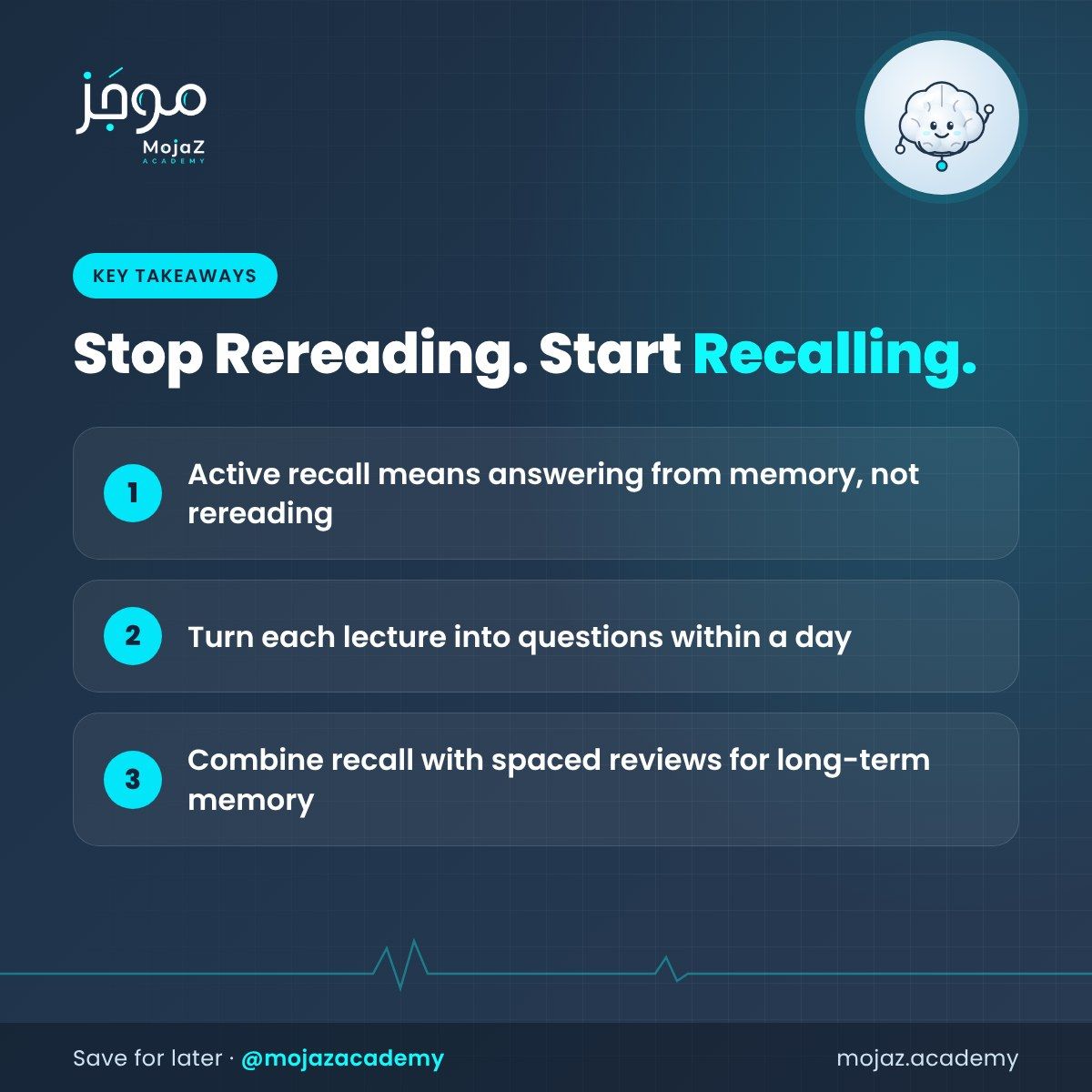
Active recall is the act of retrieving a fact, a process or a diagram without looking at it. The effort of retrieving is the point: each successful attempt makes the memory easier to reach next time. In a classic experiment, students who tested themselves remembered more a week later than students who restudied the same text (Roediger & Karpicke, 2006).
Highlighting, rereading and watching a lecture twice are passive. They create a feeling of familiarity, which is not the same as being able to answer a question about it.
How do you turn a lecture into recall practice?
- Read once for understanding. You cannot recall what you never understood.
- Write questions, not summaries. For each slide or heading, write one or two questions: 'What are the branches of the brachial plexus?' or 'Why does the oxygen curve shift right in exercise?'
- Close everything and answer. Say it out loud, write it on a blank page or draw it.
- Check and mark. Correct what you missed in a different colour. Those gaps are your next session's starting point.
Which recall formats work for medicine?
- Blank-page recall: write everything you remember about a topic, then compare with your notes. Great for pathways like the Krebs cycle.
- Question lists: a column of questions with answers hidden. Fast to review on the bus.
- Diagram redraws: redraw the nephron or the heart valves from memory and label them.
- Flashcards: ideal for terms, definitions and single facts. Read our guide to making flashcards that stick.
- Past-paper MCQs: the closest practice to the real exam, best used after the first round of learning.
How often should you recall?
Active recall becomes much stronger when combined with spacing: review the same questions after a day, then a few days later, then a week or two later. Each round should feel slightly hard. If it feels easy, you can wait longer before the next review.
Keep a simple tracker for each topic with the dates you reviewed it and how well you did. Topics you keep missing come back sooner.
What mistakes make active recall fail?
- Writing questions so vague that any answer feels right.
- Peeking at the answer after two seconds instead of struggling a little.
- Making hundreds of cards and never reviewing them.
- Only recalling isolated facts and never explaining mechanisms.
If you are not sure how to fit recall into your week, a one-to-one academic study consultation can help you build a personal study plan around your timetable and subjects.
Frequently asked questions
Is active recall better than making summaries?
Summaries help you organise a topic, but they are still passive if you only reread them. Use summaries to understand, then switch to questions and blank-page recall to remember.
How long should an active recall session be?
Short, focused sessions work well, for example 25 to 45 minutes per topic. What matters is that you retrieve the information yourself and check your mistakes.
Can I use active recall for anatomy and physiology?
Yes. For anatomy, redraw and label structures from memory. For physiology, explain a mechanism step by step out loud, then check it against your notes.
Test yourself
1. Which of the following study activities is an example of active recall?
- A. Highlighting key lines in the textbook
- B. Rereading the lecture slides before sleep
- C. Writing everything you remember about a topic on a blank page
- D. Watching the recorded lecture a second time
Show answer
Answer: C. Writing everything you remember about a topic on a blank page. Blank-page recall forces you to retrieve information from memory. Highlighting, rereading and rewatching are passive: they build familiarity, not retrieval.
2. Why can rereading and highlighting mislead students about how well they know a topic?
- A. They create a feeling of familiarity, not the ability to answer questions
- B. They take too little time to be useful
- C. They only work for anatomy, not physiology
- D. They make you forget faster than not studying at all
Show answer
Answer: A. They create a feeling of familiarity, not the ability to answer questions. Passive review makes material feel familiar, but familiarity is not the same as being able to retrieve and use it in an exam.
3. A student writes questions for each slide, but whenever she gets stuck she checks the answer after two seconds. Which change would make her active recall more effective?
- A. Make many more questions per lecture
- B. Struggle to retrieve the answer a little before checking
- C. Replace the questions with highlighted summaries
- D. Write vaguer questions so any answer feels right
Show answer
Answer: B. Struggle to retrieve the answer a little before checking. The effort of retrieval is what strengthens memory. Peeking too early removes that effort; vague questions are another common mistake the article warns against.
Keep learning
 How to Learn Medical Terminology Fast (Without Cramming)
 How to Study Anatomy Without Memorising Everything
 The Action Potential Explained Step by Step
Study this with Mojaz
References
- Roediger HL 3rd, Karpicke JD. Test-enhanced learning: taking memory tests improves long-term retention. Psychol Sci. 2006;17(3):249-255. DOI
- Larsen DP, Butler AC, Roediger HL 3rd. Test-enhanced learning in medical education. Med Educ. 2008;42(10):959-966. DOI
- Cepeda NJ, Pashler H, Vul E, Wixted JT, Rohrer D. Distributed practice in verbal recall tasks: a review and quantitative synthesis. Psychol Bull. 2006;132(3):354-380. DOI
- Dunlosky J, Rawson KA, Marsh EJ, Nathan MJ, Willingham DT. Improving students' learning with effective learning techniques: promising directions from cognitive and educational psychology. Psychol Sci Public Interest. 2013;14(1):4-58. DOI
Medically reviewed by: Lina Haddad, MD, MSc in Medical Education · Medical Education Specialist · Updated 27 Oct 2026
Want a study plan built around you?
A one-to-one Mojaz academic consultation with a personalised study plan.
Book Your ConsultationMojaz in 60 seconds, every week
Short explainers, exam tips and study tricks on our socials. Follow us and save this for later.