
Start with the anatomical position
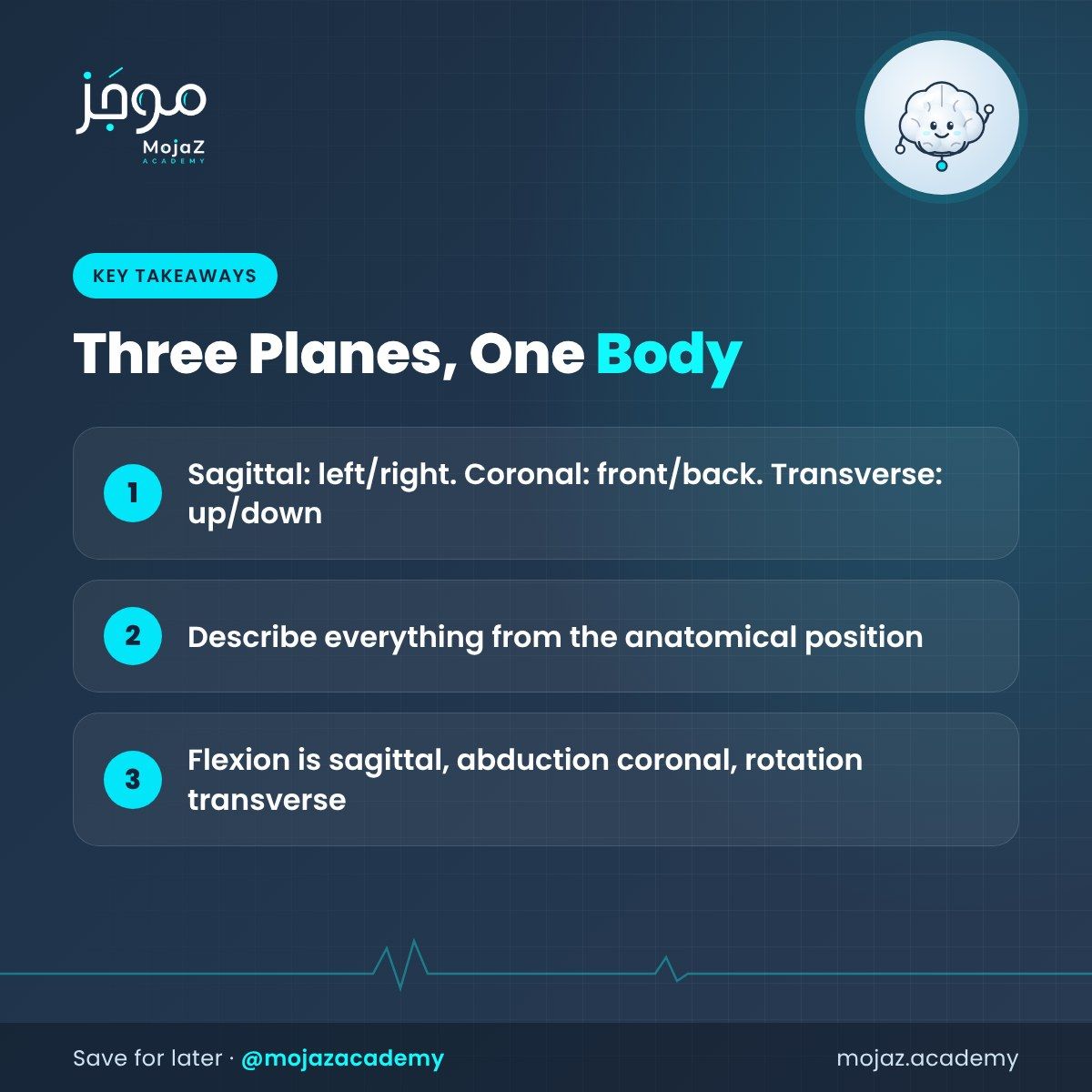
Every plane and direction assumes the anatomical position, as defined in Moore's Clinically Oriented Anatomy: standing upright, facing forward, arms by the sides, palms facing forward and feet together. Even if a patient is lying down, anatomists describe structures as if the body were in this position. This keeps descriptions consistent between textbooks, labs and clinics, so left and right always mean the patient's left and right, never yours.
The three main planes
| Plane | Also called | Divides the body into |
|---|---|---|
| Sagittal | Median (when exactly in the midline) | Left and right parts |
| Coronal | Frontal | Anterior (front) and posterior (back) parts |
| Transverse | Axial, horizontal | Superior (upper) and inferior (lower) parts |
- Midsagittal (median) plane: the sagittal plane exactly in the midline, giving equal left and right halves.
- Parasagittal plane: any sagittal plane parallel to the midline but off-centre.
- Oblique plane: any slice at an angle that is not one of the three main planes.
How to remember them quickly
Think of an arrow shot straight at you: it would pass through you front to back, along a sagittal plane (the word comes from the Latin for arrow). The coronal plane runs like a headband from ear to ear across the crown of the head. The transverse plane cuts across the body like a belt or a waistline.
Planes and movement
Planes are also used to describe movement. Each basic movement happens in a typical plane:
- Flexion and extension: sagittal plane.
- Abduction and adduction: coronal plane.
- Medial and lateral rotation: transverse plane.
Linking each movement to its plane makes joint and muscle questions far easier to reason through. For the matching vocabulary of position, see anatomical terms of direction.
Planes in CT and MRI
Radiology uses the same planes. CT is most often viewed in axial slices, while MRI and reconstructed CT also show sagittal and coronal views. By convention, axial images are usually viewed as if looking up from the patient's feet, so the patient's left side appears on the viewer's right.
Planes are one of the first building blocks of anatomy, and they come back in every region and every scan you study. To follow anatomy in the order your programme teaches it, explore the Mojaz course catalogue by university and study year.
Frequently asked questions
Is the coronal plane the same as the frontal plane?
Yes. Coronal and frontal are two names for the same plane, which divides the body into anterior and posterior parts.
What is the difference between midsagittal and parasagittal?
The midsagittal (median) plane runs exactly through the midline and gives equal halves. A parasagittal plane is parallel to it but off to one side.
Why is the transverse plane called axial?
Because it lies at right angles to the long axis of the body. In imaging, axial is the usual term for transverse slices.
Test yourself
1. Which plane divides the body into anterior and posterior parts?
- A. Sagittal plane
- B. Coronal (frontal) plane
- C. Transverse plane
- D. Median plane
Show answer
Answer: B. Coronal (frontal) plane. The coronal plane, also called the frontal plane, divides the body into front and back. Students often confuse it with the sagittal plane, which divides left from right.
2. In which plane do abduction and adduction mainly occur?
- A. Sagittal plane
- B. Transverse plane
- C. Oblique plane
- D. Coronal plane
Show answer
Answer: D. Coronal plane. Abduction and adduction occur in the coronal plane. Flexion and extension occur in the sagittal plane, and medial and lateral rotation in the transverse plane.
3. A CT slice shows the abdomen cut into upper and lower parts at the level of the kidneys. Which plane is this image in?
- A. Axial (transverse)
- B. Coronal
- C. Parasagittal
- D. Midsagittal
Show answer
Answer: A. Axial (transverse). A slice dividing the body into superior and inferior parts is transverse, called axial in imaging. CT is most often viewed in axial slices.
Keep learning
 How to Study Anatomy Without Memorising Everything
 Medical Prefixes List: Common Prefixes Every Student Needs
 How to Learn Medical Terminology Fast (Without Cramming)
Study this with Mojaz
References
- Dalley AF II, Agur AMR. Moore's Clinically Oriented Anatomy. 10th ed. Wolters Kluwer; 2026. Source
- Drake RL, Vogl AW, Mitchell AWM. Gray's Anatomy for Students. 5th ed. Elsevier; 2024. Source
- Federative International Programme for Anatomical Terminology (FIPAT). Terminologia Anatomica, 2nd edition. 2019. Source
Medically reviewed by: Julian Varell, MD, PhD in Human Anatomy · Anatomy & Physiology Instructor · Updated 27 Oct 2026
Find your subject, made brief
Mojaz courses sorted by university, programme and study year.
Browse coursesMojaz in 60 seconds, every week
Short explainers, exam tips and study tricks on our socials. Follow us and save this for later.