
Prefixes for amount and number
- a-/an-: without, absence of. Example: anaemia (a lack of red blood cells or haemoglobin), apnoea (absence of breathing).
- hyper-: above, excessive. Example: hypertension.
- hypo-: below, deficient. Example: hypoglycaemia.
- poly-: many, much. Example: polyuria (passing a large volume of urine).
- olig-: few, scanty. Example: oliguria.
- hemi-: half. Example: hemiplegia (paralysis of one side of the body).
- bi-: two. Example: bilateral.
Prefixes for position and location
- endo-: within. Example: endocardium, the inner lining of the heart.
- epi-: upon, above. Example: epidermis.
- peri-: around. Example: pericardium.
- sub-: below, under. Example: subcutaneous.
- inter-: between. Example: intercostal (between the ribs).
- intra-: inside. Example: intravenous.
- retro-: behind. Example: retroperitoneal.
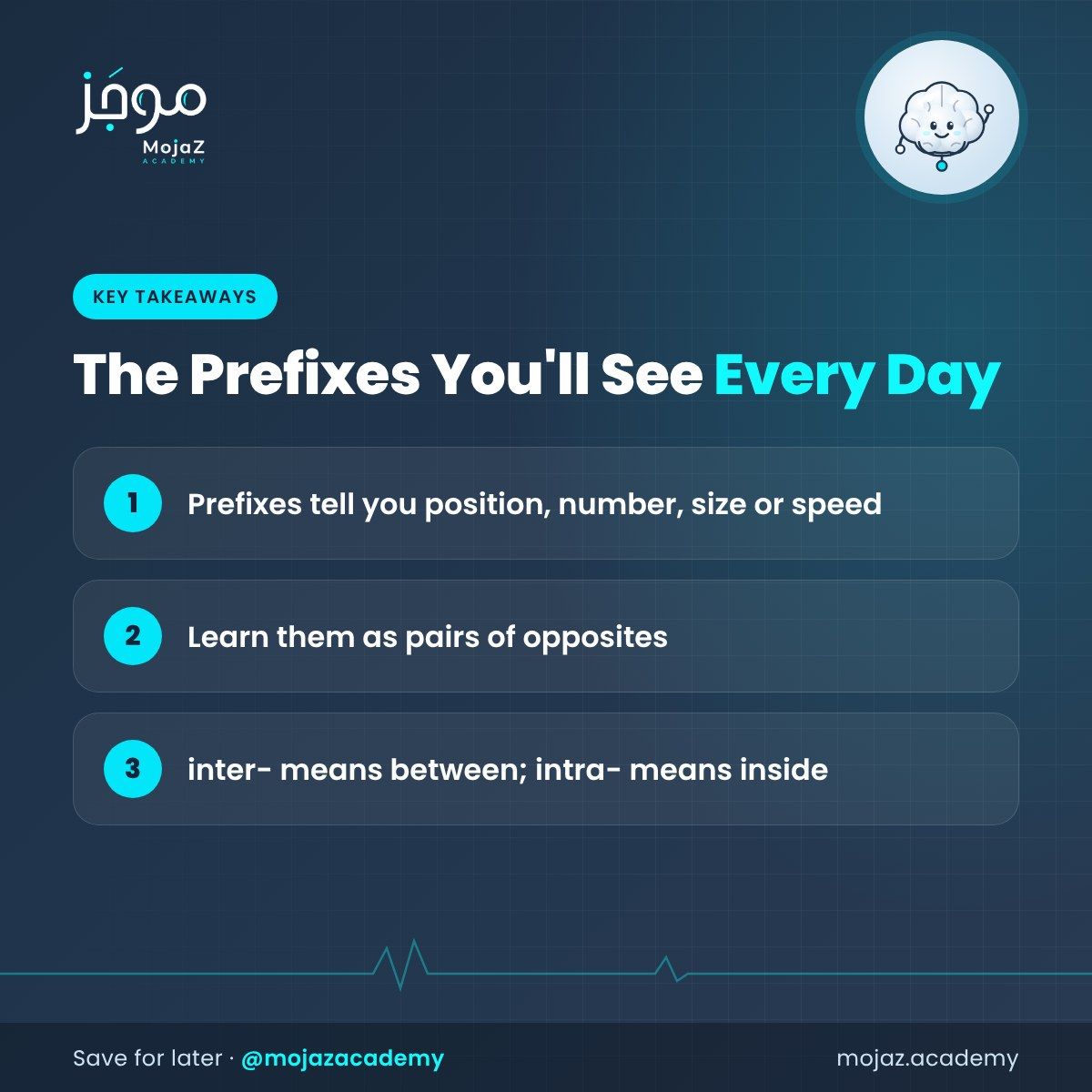
The pair inter- and intra- causes the most mistakes. Think of inter-national (between countries) and intra-net (inside one company).
Prefixes for speed, size, quality and time
| Prefix | Meaning | Example |
|---|---|---|
| tachy- | fast | tachycardia |
| brady- | slow | bradycardia |
| macro- / micro- | large / small | macrocytic / microcytic |
| dys- | difficult, painful, abnormal | dysphagia |
| neo- | new | neonate |
Time and direction prefixes complete the core set:
- pre-: before. Example: prenatal.
- post-: after. Example: postoperative.
- anti-: against. Example: antibody, antibiotic.
- contra-: opposite, against. Example: contralateral (on the opposite side of the body).
- ipsi-: same. Example: ipsilateral (on the same side).
Contralateral and ipsilateral appear constantly in neuroanatomy, so learn them as a pair early. When a lecturer says a pathway crosses over, the effect is contralateral.
How to read a term that starts with a prefix
Read the suffix first, then the root, then add the prefix as the final detail, the approach taught in Chabner's The Language of Medicine. Take bradycardia: -ia is a condition, cardi is the heart, and brady- tells you the heart is slow. Try the same with subcutaneous: -ous means relating to, cutane is skin, and sub- places it under the skin.
This order works because the prefix rarely changes the type of word; it only adds position, amount or speed. Once the core is clear, the prefix simply sharpens the picture.
How to practise prefixes
Prefixes only become useful when you combine them with roots and suffixes. Once these feel familiar, move on to the common medical suffixes and what they mean, then start splitting every new term you meet in lectures. For a guided route through prefixes, roots and suffixes with practice exercises, explore the Mojaz Medical Terminology course.
Frequently asked questions
What is a prefix in medical terminology?
It is the word part placed at the beginning of a term to modify its meaning. For example, brady- (slow) added to cardia (heart) gives bradycardia, a slow heart rate.
Does every medical term have a prefix?
No. Many terms are made of just a root and a suffix, such as gastritis or cardiology. A prefix is added only when the meaning needs it.
What is the difference between hyper- and hypo-?
Hyper- means above or excessive, while hypo- means below or deficient. Hyperglycaemia is high blood glucose and hypoglycaemia is low blood glucose.
Test yourself
1. Which prefix means 'between', as in intercostal?
- A. intra-
- B. inter-
- C. peri-
- D. sub-
Show answer
Answer: B. inter-. Inter- means between (intercostal: between the ribs). Intra- means inside, as in intravenous; this pair causes the most mix-ups.
2. What does the prefix 'dys-' mean, as in dysphagia?
- A. Without or absent
- B. Fast
- C. New
- D. Difficult, painful or abnormal
Show answer
Answer: D. Difficult, painful or abnormal. Dys- means difficult, painful or abnormal, so dysphagia is difficulty swallowing. Absence is a-/an-, fast is tachy- and new is neo-.
3. A lecturer explains that a pathway crosses over to the other side of the body. Relative to where it starts, which term describes the side of its effect?
- A. Contralateral
- B. Ipsilateral
- C. Bilateral
- D. Proximal
Show answer
Answer: A. Contralateral. Contra- means opposite, so contralateral is the opposite side; ipsi- means same. When a pathway crosses over, the effect is contralateral.
Keep learning
 How to Learn Medical Terminology Fast (Without Cramming)
 How to Study Anatomy Without Memorising Everything
 Spaced Repetition in Medicine: A Simple Schedule That Works
Study this with Mojaz
References
- Chabner DE. The Language of Medicine. 13th ed. Elsevier; 2025. Source
- Federative International Programme for Anatomical Terminology (FIPAT). Terminologia Anatomica, 2nd edition. 2019. Source
Medically reviewed by: Elina Vossler, MD, MSc in Medical Education · Medical Education Specialist · Updated 27 Oct 2026
Learn the language of medicine, step by step
The Mojaz Medical Terminology course: roots, prefixes and suffixes in short, clear units.
Explore the courseMojaz in 60 seconds, every week
Short explainers, exam tips and study tricks on our socials. Follow us and save this for later.