
Why does memorising fail in physiology?
Physiology is about how the body works, so most exam questions describe a change and ask what happens next. A memorised list cannot answer a question you have not seen before. A mechanism can, because you simply follow it forward.
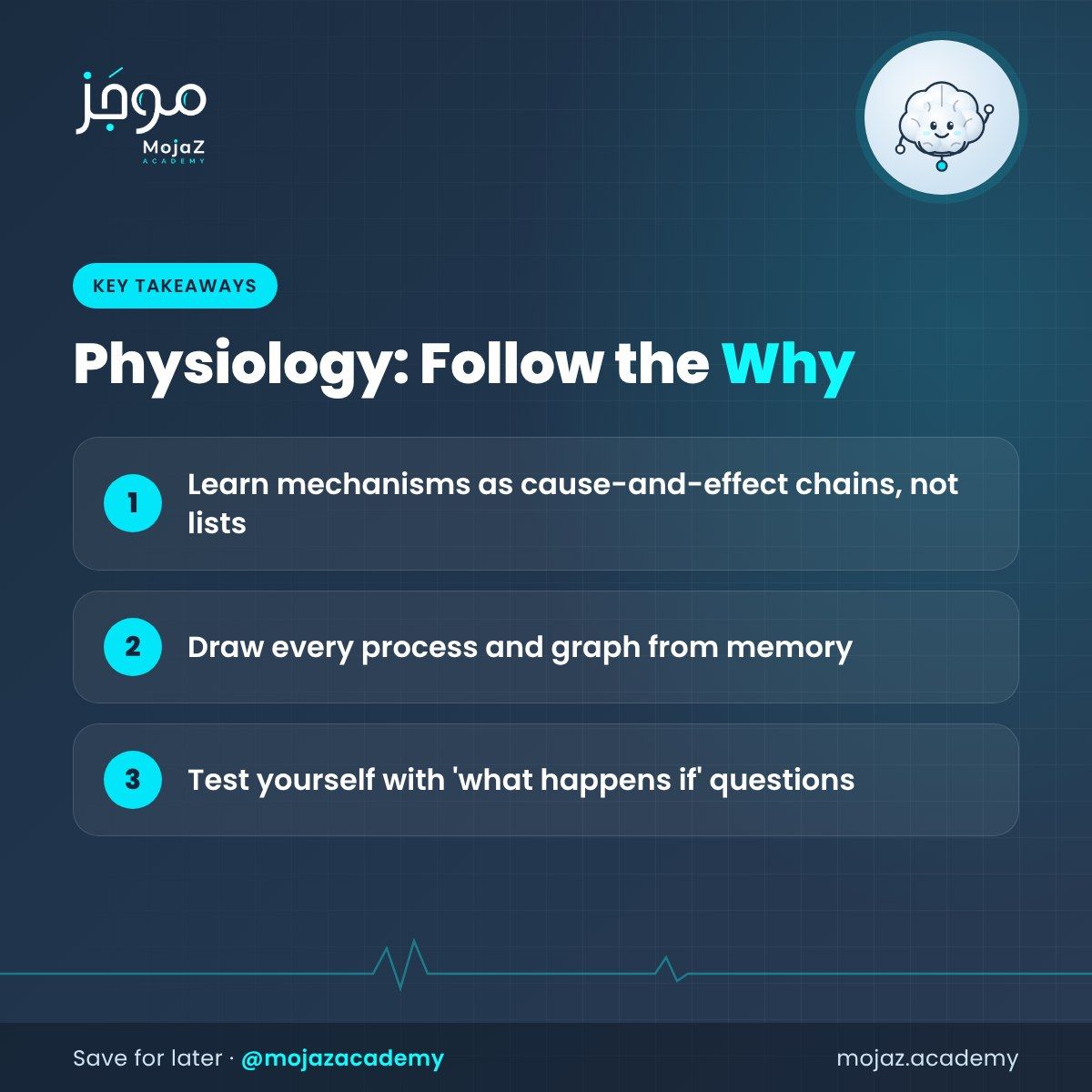
Think of each topic as a chain: a stimulus, a sensor, a response and a result, the control-system view that runs through Guyton and Hall. Once you see the chain, the details hang on it naturally.
Step 1: Start with the big picture
Before the lecture details, write one sentence on the purpose of the system. The kidney keeps the internal environment stable. The heart pumps blood to meet the tissues' needs. The lungs exchange oxygen and carbon dioxide.
- Read the chapter summary or headings first.
- Ask: what problem is this system solving?
- Only then add the numbers and named structures.
Step 2: Draw every process
Physiology is visual. Sketch flow diagrams with arrows: up arrows for increase, down arrows for decrease. Draw the cardiac cycle, the nephron or a feedback loop from memory, then check it against your notes.
Graphs deserve special attention. Learn what is on each axis and what shifts the curve, because exams love to ask what happens when a variable changes.
Step 3: Ask "what if" questions
Test yourself with prediction questions. What happens to heart rate if blood pressure suddenly drops? What happens to urine output if ADH rises? Write your answer, then trace the mechanism to see if you were right.
- Pick one variable.
- Change it up or down.
- Predict every effect along the chain.
- Check with your textbook or lecture.
A good place to practise this is the action potential, explained step by step, where each phase follows from the one before.
Step 4: Connect it, then review it
Link each mechanism to anatomy and to a simple clinical idea. Knowing where the nephron sits helps you understand what it does; knowing what dehydration is helps you remember ADH. These connections turn isolated facts into a network you can recall under pressure.
Before exams, use active recall and spaced review rather than rereading. Redraw your diagrams from a blank page, answer past-style questions, and revisit hard topics a few days later. If you want structured lessons organised by your university and study year, browse the Mojaz course catalogue.
Frequently asked questions
Is physiology harder than anatomy?
They are hard in different ways. Anatomy needs more memorisation, while physiology needs more understanding of how processes connect. Students who focus on mechanisms usually find physiology more logical over time.
Should I memorise normal values in physiology?
Learn the key normal values your course highlights, but always alongside the mechanism. A number makes sense when you know what raises or lowers it.
How long should I study physiology each day?
There is no fixed number. Short, focused sessions with active recall and regular review work better than long passive reading.
Test yourself
1. When studying a physiology topic as a control chain, which sequence should you follow?
- A. Name, definition, normal value, disease
- B. Lecture, summary, flashcard, exam
- C. Stimulus, sensor, response, result
- D. Anatomy, histology, pathology, pharmacology
Show answer
Answer: C. Stimulus, sensor, response, result. Each topic can be seen as a chain of stimulus, sensor, response and result, the control-system view used in physiology texts. Once the chain is clear, the details hang on it.
2. What is the most useful way to study a physiology graph?
- A. Learn what is on each axis and what shifts the curve
- B. Memorise the exact shape without labels
- C. Skip graphs and learn the text only
- D. Copy the graph from the slides several times
Show answer
Answer: A. Learn what is on each axis and what shifts the curve. Exams often ask what happens when a variable changes, so knowing the axes and what shifts the curve lets you predict the answer instead of recalling a picture.
3. A student has read the ADH lecture twice. Which activity best applies prediction ('what if') questions?
- A. Rereading the lecture a third time
- B. Copying the slide diagrams neatly
- C. Highlighting key terms in the notes
- D. Predicting what happens to urine output if ADH rises, then tracing the mechanism to check
Show answer
Answer: D. Predicting what happens to urine output if ADH rises, then tracing the mechanism to check. Prediction questions change one variable and ask you to follow its effects along the chain, then check against the textbook. Rereading and highlighting are passive and test nothing.
Keep learning
 The Action Potential Explained Step by Step
 Active Recall for Medical Students: How to Actually Use It
 Anatomical Planes Explained: Sagittal, Coronal, Transverse
Study this with Mojaz
References
- Hall JE, Hall ME. Guyton and Hall Textbook of Medical Physiology. 15th ed. Elsevier; 2026. Source
- Costanzo LS. Costanzo Physiology. 8th ed. Elsevier; 2027. Source
- Chi MTH, de Leeuw N, Chiu MH, LaVancher C. Eliciting self-explanations improves understanding. Cogn Sci. 1994;18(3):439-477. DOI
- Roediger HL 3rd, Karpicke JD. Test-enhanced learning: taking memory tests improves long-term retention. Psychol Sci. 2006;17(3):249-255. DOI
Medically reviewed by: Samer Khalil, MBBS, PhD in Human Physiology · Senior Physiology Instructor · Updated 27 Oct 2026
Find your subject, made brief
Mojaz courses sorted by university, programme and study year.
Browse coursesMojaz in 60 seconds, every week
Short explainers, exam tips and study tricks on our socials. Follow us and save this for later.