
Why does spacing beat cramming?
Memory fades quickly after you first learn something; this pattern is known as the forgetting curve. Reviews spread out over time produce better long-term retention than the same amount of massed study (Cepeda et al., 2006).
Cramming can carry you through tomorrow's quiz and often feels more effective, yet spaced practice leads to better long-term learning (Kornell, 2009). Medicine is cumulative: the physiology you learn in year one returns in pathology and pharmacology.
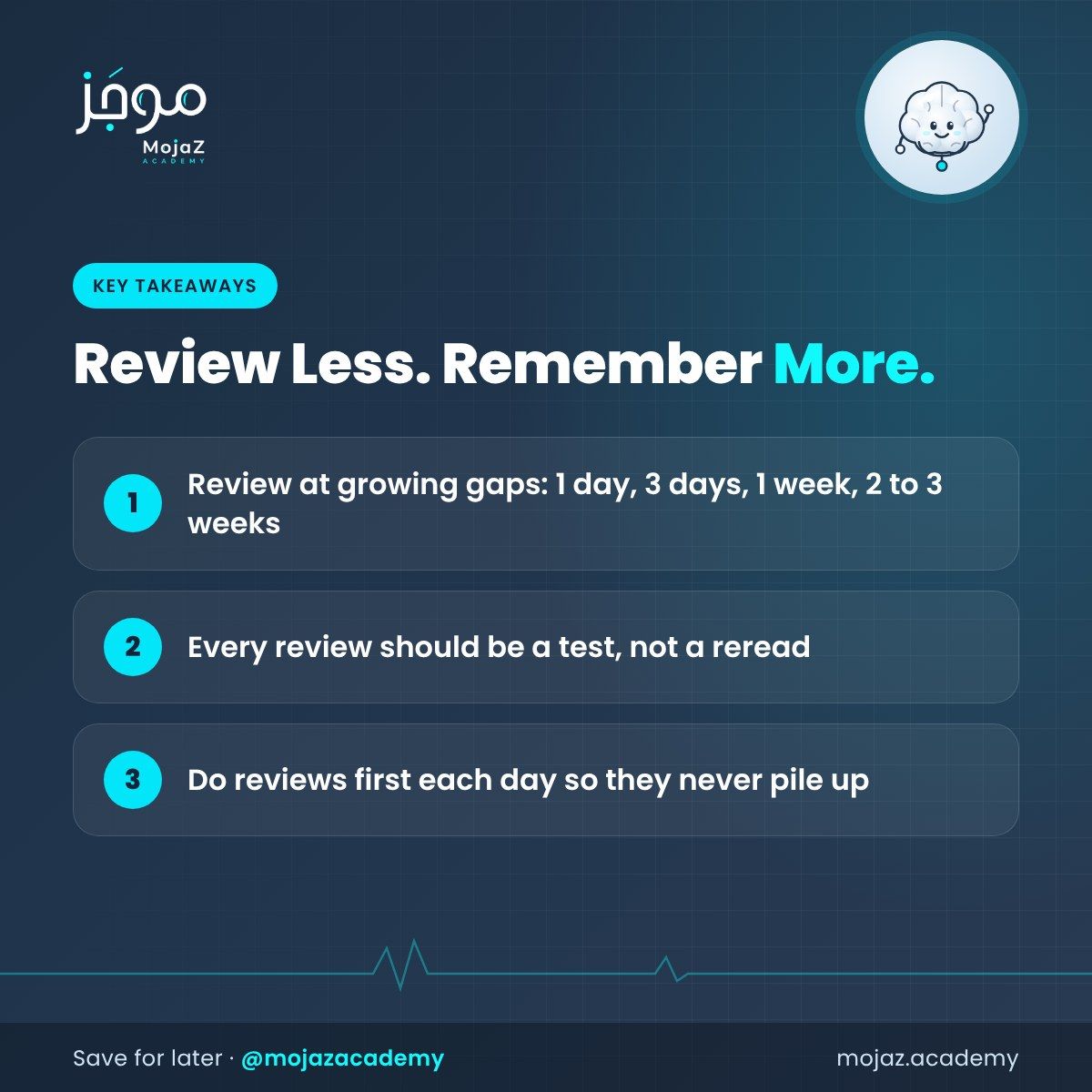
A simple schedule you can start today
| Review | When | What to do |
|---|---|---|
| 1 | Same day or next day | Answer your lecture questions from memory |
| 2 | After 3 days | Blank-page recall, then fix gaps |
| 3 | After 1 week | Mixed questions with other topics |
| 4 | After 2 to 3 weeks | Past-paper MCQs on the topic |
| 5 | Before the exam | Quick final pass on weak points only |
If a review goes badly, shorten the next gap. If it feels easy, stretch it.
Do you need an app?
No. A spaced repetition app schedules flashcards for you automatically, which is useful for terms, drug names and single facts. But for whole topics, a paper or spreadsheet tracker works just as well.
- List each lecture in a row.
- Add columns for review dates 1 to 5.
- Colour each cell green, yellow or red based on how well you did.
The red cells become your priority list for the week.
How do you keep the review pile manageable?
- Review with recall, not rereading. Spacing only works if each review is a real test. Our guide to active recall for medical students shows how.
- Keep cards and questions short. One fact per card means faster reviews.
- Do not add what you do not understand. Understand first, then schedule.
- Cap new material on heavy days. If reviews are overflowing, slow down new cards for a few days.
Where does spaced repetition fit in your week?
Think of it as a fixed slot, not an extra task: reviews in the morning, new lectures in the afternoon, a short recall session at night. Fitting this around labs, clinical days and family time is where most students struggle.
If you want help building that structure around your own timetable, a one-to-one academic study consultation gives you a personalised study plan you can actually follow.
Frequently asked questions
What is the best spaced repetition schedule for medical students?
A simple starting point is to review after 1 day, 3 days, 1 week and 2 to 3 weeks. Adjust the gaps: shorter if you struggle, longer if it feels easy.
Is spaced repetition only for flashcards?
No. You can space any form of recall, including blank-page summaries, diagram redraws and practice questions on a whole topic.
What if I fall behind on my reviews?
Pause new material for a few days and clear the oldest and weakest reviews first. Shorter, more frequent sessions help you catch up without burning out.
Test yourself
1. What does spaced repetition mean?
- A. Reviewing the same material at growing intervals over time
- B. Studying a topic in one long session the night before
- C. Reviewing every topic once a day at the same time
- D. Rereading notes many times within one day
Show answer
Answer: A. Reviewing the same material at growing intervals over time. Spaced repetition spreads reviews over growing gaps. Studying everything in one sitting is massed practice, or cramming.
2. According to the article, what should you do if a spaced review goes badly?
- A. Stretch the next gap
- B. Delete the card and move on
- C. Shorten the next gap
- D. Stop reviewing that topic until the exam
Show answer
Answer: C. Shorten the next gap. A poor review means the memory is weak, so the next review should come sooner. If a review feels easy, you can stretch the gap instead.
3. A student crams pharmacology the night before a quiz and does well, but has forgotten most of it by the final exam. Which explanation fits best?
- A. Cramming always gives better long-term memory than spacing
- B. Pharmacology cannot be learned with spacing
- C. She needed a flashcard app to remember it
- D. Massed study helps short term, but spaced practice gives better long-term retention
Show answer
Answer: D. Massed study helps short term, but spaced practice gives better long-term retention. Cramming can carry you through tomorrow's quiz, but reviews spread out over time produce better long-term retention. An app is optional, not the cause.
Keep learning
 Active Recall for Medical Students: How to Actually Use It
 How to Learn Medical Terminology Fast (Without Cramming)
 How to Study Anatomy Without Memorising Everything
Study this with Mojaz
References
- Cepeda NJ, Pashler H, Vul E, Wixted JT, Rohrer D. Distributed practice in verbal recall tasks: a review and quantitative synthesis. Psychol Bull. 2006;132(3):354-380. DOI
- Kornell N. Optimising learning using flashcards: spacing is more effective than cramming. Appl Cogn Psychol. 2009;23(9):1297-1317. DOI
- Dunlosky J, Rawson KA, Marsh EJ, Nathan MJ, Willingham DT. Improving students' learning with effective learning techniques: promising directions from cognitive and educational psychology. Psychol Sci Public Interest. 2013;14(1):4-58. DOI
- Roediger HL 3rd, Karpicke JD. Test-enhanced learning: taking memory tests improves long-term retention. Psychol Sci. 2006;17(3):249-255. DOI
Medically reviewed by: Dana Saleh, MSc in Healthcare Education · Healthcare Training Specialist · Updated 27 Oct 2026
Want a study plan built around you?
A one-to-one Mojaz academic consultation with a personalised study plan.
Book Your ConsultationMojaz in 60 seconds, every week
Short explainers, exam tips and study tricks on our socials. Follow us and save this for later.